

Views: 350 Author: Lasting Titanium Publish Time: 2026-03-13 Origin: Site


Content Menu
>> The Foundation of Precision: Metallurgical Integrity
>> Advanced Manufacturing Technologies: From Forging to Finished Part
>>> The Science of Thread Rolling and Stress Management
>>> High-Speed CNC Machining Capabilities
>> Comprehensive Quality Management Systems
>>> Dimensional and Geometrical Verification
>>> Internal Integrity and NDT
>>> Chemical and Mechanical Validation
>> Dedicated to Operational Excellence in the Global Market
In the demanding realm of aerospace engineering, high-performance automotive manufacturing, and specialized chemical processing, the integrity of a complex assembly is only as reliable as the smallest fastener that holds it together. When dealing with titanium—a material celebrated for its exceptional strength-to-weight ratio, superior fatigue resistance, and remarkable corrosion stability in aggressive media—the manufacturing process must be executed with absolute, uncompromising technical rigor. At Shaanxi Lasting Advanced Titanium, we recognize that our clients do not just procure industrial hardware; they invest in the operational security of their most critical systems. Ensuring this level of precision requires a multi-layered synergy of advanced metallurgical control, state-of-the-art manufacturing automation, and a robust quality management framework that aligns with the realities of modern industrial standards.
Precision begins far upstream from the CNC turning center; it starts at the atomic level of the raw material. Titanium alloys, particularly workhorse grades like Ti-6Al-4V, are sensitive to thermal gradients and atmospheric contamination during the melt and forging phases. Even minor fluctuations in the chemical composition can alter the phase distribution—specifically the alpha and beta grain structure—which directly dictates the final mechanical performance, including tensile strength, ductility, and fracture toughness.
At Shaanxi Lasting, we exercise rigorous control over our raw material supply chain. By utilizing high-purity sponge titanium and adhering to validated vacuum arc remelting protocols, we aim to ensure that every ingot meets the target chemical homogeneity required by the intended grade. During the forging process, we employ precise temperature controls and strain rate monitoring to encourage uniform recrystallization. This meticulous approach to grain refinement is essential; if the initial metallurgical structure is irregular, no amount of precision machining can compensate for the underlying lack of structural integrity. By maintaining a highly controlled microstructure from the ingot stage through to the final product, we ensure that our fasteners exhibit consistent performance under the extreme thermal and mechanical stresses encountered in engine compartments or structural airframe joints.
To achieve the tight tolerances required for high-performance applications, reliance on conventional machining is insufficient. Our production facility integrates automated high-speed machining and proprietary cold-working technologies designed specifically to handle the unique mechanical response of titanium.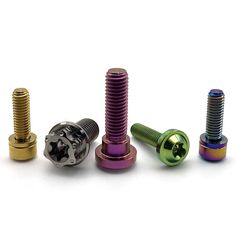
The threaded section is the most critical stress concentration point on any fastener. In titanium, traditional thread cutting can disrupt the material's natural grain flow, potentially creating micro-cracks or stress risers. Shaanxi Lasting utilizes advanced, computer-controlled thread rolling technology. By plasticly deforming the titanium to form the threads, we maintain a continuous grain flow that conforms to the thread profile, which is a key factor in enhancing fatigue resistance. This process creates a beneficial compressive residual stress layer at the thread root. While the magnitude of this stress is carefully calibrated through specialized tooling geometry and rolling pressures tailored to the specific alloy grade, the result is a thread profile that provides superior dimensional consistency and reliable load-bearing performance.
Beyond thread formation, the head geometry, drive system, and shank tolerance of our fasteners are managed through sophisticated, multi-axis CNC centers. Titanium's low thermal conductivity poses a challenge, as heat buildup at the tool-workpiece interface can lead to rapid tool degradation. We mitigate this through high-pressure, through-spindle coolant delivery systems and high-performance coated carbide or advanced ceramic tooling geometries designed to maximize chip evacuation and thermal dissipation. Our CNC units are integrated with in-process probing systems that monitor critical dimensions throughout the cycle. This level of automation, supported by Statistical Process Control (SPC), ensures that we maintain repeatable dimensional precision across high-volume production batches.
For the professional in the titanium industry, precision is a continuous, data-driven process. At Shaanxi Lasting, we have institutionalized a quality management system that treats inspection as an integrated, diagnostic component of our production workflow.
Our quality lab utilizes coordinate measuring machines (CMM) and non-contact optical inspection systems to verify complex geometric features—such as head-to-shank perpendicularity—to within specified micro-level tolerances. We rely on a combination of rigorous first-article inspection (FAI) and ongoing SPC monitoring. This approach allows us to track production trends, such as tool wear patterns, and implement proactive adjustments to maintain compliance with established aerospace, military, and commercial standards, including AS (Aerospace Standards), NAS (National Aerospace Standards), and ISO specifications.
Sub-surface integrity is a paramount concern with titanium, particularly for parts subject to cyclical loading. We employ advanced non-destructive testing (NDT) techniques as standard for critical hardware. This includes ultrasonic testing to detect internal voids or inclusions that would be invisible to external inspection. Furthermore, we utilize fluorescent penetrant inspection (FPI) to ensure the surface is free from microscopic tears or forging laps that could compromise the fastener's structural life in service.
Every lot produced at our facility is backed by full material traceability. This includes destructive validation testing, such as tensile tests conducted at both ambient and elevated temperatures to ensure compliance with specific material specifications. Chemical composition is verified using optical emission spectrometry, ensuring that interstitial elements—such as oxygen, nitrogen, and hydrogen—remain within tightly controlled limits to prevent embrittlement and maintain performance consistency.
The differentiator for Shaanxi Lasting lies in the synergy between our technical expertise, our industrial infrastructure, and our culture of quality. We recognize that the global titanium fastener market requires not just standard parts, but engineered solutions. By investing in our internal R&D and manufacturing capacity, we ensure that we remain at the forefront of the industry. Our production environment includes dedicated zones and specialized tooling for titanium processing to minimize the risk of cross-contamination and ensure that our materials retain their intended metallurgical properties.
When we discuss precision at Shaanxi Lasting, we are talking about the elimination of process variables. We are talking about the rigorous maintenance of metallurgical standards, the employment of cold-working thread formation to improve grain structure, and the integration of automated monitoring in our CNC operations. For our partners in the aerospace and industrial sectors, this level of attention provides the ultimate value: the certainty that every fastener in a production run will perform as intended under the most demanding conditions.
Q: How does thread rolling optimize the fatigue life of titanium fasteners?
A: Thread rolling is a cold-working process that does not break the metal's grain fibers. Instead, it reconfigures the grain structure to follow the thread contour and creates a compressive residual stress layer at the thread root. This effectively retards crack initiation and growth, which are the primary modes of failure under high-cycle fatigue conditions.
Q: What protocols are in place to ensure material purity and prevent cross-contamination?
A: We maintain designated production zones and utilize titanium-specific tooling and fixtures. This segregation prevents the introduction of contaminants from ferrous or other metals that could lead to galvanic corrosion or structural degradation. All handling equipment and contact surfaces are subject to strict cleanliness standards throughout the manufacturing lifecycle.
Q: How does Shaanxi Lasting manage the development of custom fasteners for specific industrial needs?
A: We provide comprehensive engineering support, collaborating with client teams to evaluate performance requirements and environmental conditions. We utilize CAD/CAM modeling and, where necessary, finite element analysis (FEA) to simulate fastener performance. This allows us to optimize geometry and material selection before transitioning to production with our specialized CNC and thread-rolling equipment.
Q: What is the role of Statistical Process Control (SPC) in your quality management system?
A: SPC is critical to maintaining consistency in high-volume production. By monitoring key process parameters and dimensions in real-time, we can identify subtle trends or drifts—such as tool wear—before they result in out-of-tolerance parts. This data-driven approach allows for proactive tool adjustment, ensuring high repeatability and reliability across every batch.
Q: Why is titanium favored for fasteners in aerospace and high-stress environments?
A: Titanium provides an optimal balance of high specific strength, resistance to elevated-temperature degradation, and immunity to many forms of corrosive attack. These attributes are essential for engineers looking to reduce system weight while enhancing the structural reliability and lifespan of components exposed to harsh, high-stress operational environments.


