

Views: 350 Author: Lasting Titanium Publish Time: 2026-05-21 Origin: Site


Content Menu
● The Intersection of Advanced Metallurgy and Clinical Success
● Why ISO 13485 Is the Regulatory Foundation
● The Economic Value of Certified Quality
● Beyond Compliance: Metallurgy and Expert Oversight
● Navigating the Global Regulatory Landscape
● Future-Proofing Through Data-Driven Innovation
● Frequently Asked Questions (FAQ)
In the high-stakes world of orthopedic surgery, the integrity of a single bone screw can determine a patient's long-term quality of life. Whether utilized in spinal fusion, complex fracture fixation, or joint reconstruction, these small yet critical components must withstand the hostile, corrosive, and dynamic environment of the human body for decades. For medical device OEMs (Original Equipment Manufacturers), selecting a partner for titanium forgings is not merely a procurement decision—it is a critical risk management strategy. ISO 13485 certification stands as the global gold standard for quality management in this sector, serving as the definitive, verifiable proof that a manufacturer possesses the systems required to deliver the consistency, safety, and traceability essential for life-critical implants.
Medical-grade titanium, specifically Ti-6Al-4V ELI (Grade 23), is the industry choice for bone screws due to its exceptional biocompatibility, superior strength-to-weight ratio, and fatigue resistance. The "ELI" designation, standing for Extra Low Interstitials, is critical; it signifies that the levels of oxygen, nitrogen, and hydrogen have been strictly limited to maximize ductility and fracture toughness. However, the intrinsic properties of this alloy are only as good as the manufacturing process itself.
Titanium forging is a complex thermomechanical process that demands precise control over forging temperatures, strain rates, and cooling profiles. Each of these variables directly influences the final microstructure and mechanical fatigue resistance of the screw. If the process is not tightly controlled, the titanium can suffer from phase transformations—such as the formation of a brittle Alpha-case (α-case) layer. This layer occurs when oxygen and nitrogen diffuse into the surface at high temperatures, creating a hardened, brittle surface layer that acts as a potent crack initiation site under the cyclic loading conditions of the human body. Without a robust, ISO 13485-mandated Quality Management System (QMS), such metallurgical degradation can go undetected until the device fails in situ, causing catastrophic clinical outcomes.
For a professional supplier like Shaanxi Lasting New Material Industry Co., Ltd., maintaining ISO 13485 certification is far more than a marketing badge—it is an operational philosophy that governs every facet of the manufacturing lifecycle. While ISO 9001 provides a generic framework for business management, ISO 13485 is explicitly tailored to the stringent, high-risk environment of medical device production.
* Total Traceability (Cradle-to-Grave): ISO 13485 mandates that every finished bone screw must be traceable back to its original titanium ingot melt. This is not just for bookkeeping; it is a critical safety requirement. If a material-related concern arises, a manufacturer must be able to isolate the exact batch of titanium used, identify all associated forging histories, and execute a targeted response, ensuring patient safety without causing unnecessary supply chain disruptions.
* The Power of IQ/OQ/PQ: Unlike general manufacturing, medical device production requires rigorous Process Validation (IQ/OQ/PQ).
* Installation Qualification (IQ): Verifies that all equipment and forging presses are correctly installed and meet safety specifications.
* Operational Qualification (OQ): Demonstrates that the equipment performs consistently within the defined operational limits (e.g., pressure, dwell time, temperature).
* Performance Qualification (PQ): Proves that the process consistently produces a product meeting all predetermined mechanical requirements under normal operating conditions. This validation ensures that the quality of the bone screw is built into the process itself, not just verified by final inspection.
* Risk Management as a Core Process: The standard requires that risk management be woven into the fabric of the manufacturing lifecycle, from initial raw material sourcing to final packaging. By proactively identifying potential failure modes through formal risk assessment, we minimize the potential for material inconsistencies or contamination, ensuring that the patient's safety is the primary consideration at every stage.
While some may view strict ISO compliance as an added cost, it is actually a profound economic enabler for global brand owners and distributors. Partnering with a non-certified facility may appear cheaper in the short term, but the hidden costs associated with poor quality, regulatory bottlenecks, and the threat of product recalls far outweigh any initial savings.
| Benefit of ISO 13485 | Impact on Supply Chain and Business |
|---|---|
| Regulatory Market Access | Essential for meeting EU Medical Device Regulation (MDR) and FDA compliance. Without it, global market entry is virtually impossible. |
| Reduced Scrap and Rework | Validated processes minimize material waste and inconsistent parts, lowering the total cost of ownership per unit. |
| Risk Mitigation | ISO-governed risk management significantly reduces the probability of batch failures, protecting your brand reputation. |
| Supply Chain Trust | Consistent, traceable materials foster long-term partnerships with leading medical companies that demand audit-ready documentation. |
By adhering to these standards, Shaanxi Lasting New Material Industry Co., Ltd. provides a predictable, stable supply chain. This transparency allows our clients to forecast production schedules with high accuracy, confident that the metallurgical integrity of their raw materials remains consistent from shipment to shipment.
As industry veterans, we recognize that the most successful medical device partnerships move far beyond "passive compliance." Shaanxi Lasting New Material Industry Co., Ltd. leverages our deep-seated experience in titanium metallurgy to offer more than just forged blanks—we provide application-oriented engineering expertise.
Forging titanium for surgical applications requires a sophisticated understanding of thermodynamics and material grain structure. Our team actively monitors for issues such as uncontrolled alpha-case development, ensuring that our heat-treatment and post-forging cleaning processes are optimized to yield a clean, biocompatible, and high-fatigue-strength component. When selecting a titanium forging supplier, OEMs should prioritize partners that demonstrate:
1. Technical Cleanliness: Are there controlled, clean-room-adjacent environments to prevent particulate contamination during the transition from forging to final machining?
2. Advanced Metrology: Does the supplier utilize high-precision metrology, such as automated laser scanning or coordinate measuring machines (CMM), to ensure that complex screw profiles meet stringent tolerance requirements?
3. Domain Expertise: Does the team understand the nuanced differences in material requirements for different surgical applications, such as the specific stress levels seen in spinal pedicle screws versus maxillofacial implants?
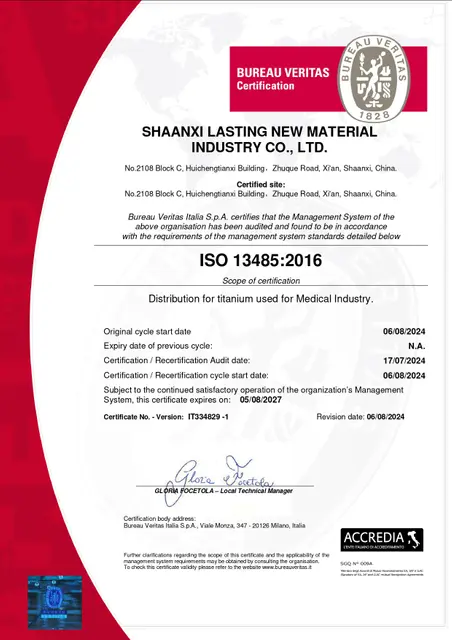
The medical device landscape is evolving rapidly. Regulations such as the EU's Medical Device Regulation (MDR) have pushed the requirements for technical documentation, clinical data, and quality oversight to new heights. For distributors and global brands, this means that every partner in their supply chain must be a contributor to their Technical File.
By maintaining a robust ISO 13485 system, we provide our partners with the necessary quality assurance documentation to breeze through regulatory audits. We view our certification not as a static end goal, but as a commitment to ongoing improvement and transparency. This partnership approach ensures that our clients are not merely buying parts, but are building a defensible quality story that they can present to international regulators with absolute confidence.
The future of orthopedic implants lies in patient-specific geometries and advanced surface treatments. As manufacturing technology advances toward hybrid models—combining additive manufacturing with traditional finishing and forging—the necessity of integrated, data-driven quality systems becomes even more apparent.
At Shaanxi Lasting New Material Industry Co., Ltd., we are aggressively investing in smart manufacturing technologies that track every critical parameter of the forging process in real-time. This "Industry 4.0" approach to ISO 13485 allows us to offer unprecedented consistency. Whether producing a standard pedicle screw or a custom, complex maxillofacial implant, the data-driven nature of our facility ensures that every individual piece is manufactured to the highest global standards.
For titanium forgings used in life-critical medical devices like bone screws, there is no substitute for the rigor, structure, and accountability provided by ISO 13485. By partnering with manufacturers who prioritize this international quality standard, OEMs and distributors ensure patient safety while safeguarding their own market reputation.
Choosing the right partner for critical titanium components is a strategic decision that reverberates through the entire downstream value chain. Shaanxi Lasting New Material Industry Co., Ltd. remains steadfast in our commitment to these stringent standards, delivering the precision, consistency, and expert metallurgical guidance that global healthcare providers demand. As we look to the future, we continue to refine our processes, ensuring that our contributions to the medical field help patients heal better, faster, and more reliably.
1. [ISO 13485: A Crucial Standard for Medical Device Manufacturing Excellence - AIP Precision Machining](https://aipprecision.com/why-its-essential-to-have-iso-13485-for-manufacturing-medical-devices/)
2. [Titanium Forging Guide 2026: Types, Benefits and Uses Explained - HDC Manufacturing](https://hdcmfg.com/resources/blog/titanium-forging/)
3. [Titanium Wire for Medical Devices: Compliance with ISO And ASTM Standards - Lasting Titanium](https://www.lastingtitanium.com/titanium-wire-for-medical-devices-compliance-with-iso-and-astm-standards.html)
4. [CNC Machining Medical Devices Supplier – Ensuring Precision & Compliance - Frigate Manufacturing](https://frigate.ai/cnc-machining/cnc-machining-medical-devices-supplier-ensuring-precision-compliance/)
5. [Titanium: biocompatibility, durability and cost-efficiency continue to improve - MedTech Intelligence](https://medtechintelligence.com/feature_article/titanium-medical-device-manufacturers/)
6. [How Orthopedic Implants Are Manufactured & Tested - SLR Medical Consulting](https://slrmedicalconsulting.com/how-orthopedic-implants-manufactured-quality-tested/)
7. [Shaanxi Lasting New Material Industry Co., Ltd. - LinkedIn](https://www.linkedin.com/company/lastingtitanium/)
1. Why is ISO 13485 specifically important for titanium bone screws compared to other standards?
ISO 13485 is the international standard specifically designed for the medical device industry. Unlike ISO 9001, it includes mandatory requirements for risk management, clinical evaluation, and strict traceability that are essential for implantable devices where failure is not an option.
2. How does the "Alpha-case" layer specifically affect bone screw safety?
During high-temperature forging, oxygen and nitrogen can diffuse into the titanium surface, forming a hard, brittle layer known as Alpha-case. If not removed, this brittle surface can initiate cracks under cyclic stress (such as human movement), leading to premature fatigue failure of the screw inside the patient.
3. What role do IQ, OQ, and PQ play in an ISO 13485-certified facility?
These validations (Installation, Operational, and Performance Qualification) are the backbone of process reproducibility. They prove that our forging presses and systems are installed correctly, operate within safe limits, and consistently produce parts that meet every mechanical specification, ensuring that quality is built into the manufacturing process.
4. How does ISO 13485 certification assist in complying with the EU MDR?
The EU Medical Device Regulation (MDR) requires exhaustive documentation regarding the manufacturing process and supply chain quality. An ISO 13485 system provides the structured data, risk files, and traceability reports that manufacturers need to include in their Technical Files to gain CE Marking.
5. How can I verify the authenticity of a manufacturer's ISO 13485 certification?
Always request a copy of the current, valid certificate from the manufacturer. You can then verify the certificate number directly on the website of the accredited registrar (the third-party audit firm that issued the certificate). This ensures the certification is both active and covers the specific scope of titanium forging.


