

Views: 300 Author: Lasting Titanium Publish Time: 2026-09-24 Origin: Site


Content Menu
● Grade 2 vs. Grade 12 titanium plate: key differences
● Why Grade 12 is considered for hot-chloride crevice corrosion
● Grade 2: a practical choice for suitable FGD locations
● Titanium corrosion resistance has limits: the passive film matters
● Grade 7 and other corrosion-resistant titanium grades
● Welding Grade 2 and Grade 12: assess the whole joint
● Hydrogen pickup: include cleaning and shutdown conditions
● A practical material-selection workflow for FGD towers
>> 1. Divide the system into service zones
>> 2. Define normal and upset conditions
>> 3. Screen Grade 2, Grade 12, and alternatives
>> 4. Review plate, welds, forming, and design code together
>> 5. Specify the purchase package
● Lifecycle cost: compare the installed solution, not only plate price
>> Is Grade 12 always better than Grade 2 for FGD towers?
>> How much higher is Grade 12's minimum tensile strength?
>> Does Grade 12's lower elongation affect forming?
>> Why might a designer choose Grade 7 instead?
>> Can minimum tensile strength be used as design allowable stress?
>> What should be checked before ordering titanium plate?
Selecting titanium plates for desulfurization towers means matching the alloy to the chemistry, temperature, and geometry of each service zone. Grade 2 titanium (UNS R50400) is commercially pure titanium, valued for formability and established fabrication practice. Grade 12 titanium (UNS R53400), nominally Ti-0.3Mo-0.8Ni, has higher minimum strength and is intended to improve resistance to crevice corrosion in hot chloride service. TIMET describes Grade 12 as stronger than Grade 2, with significant improvement in crevice-corrosion resistance in hot brines. [firmetal]
These differences matter in wet flue-gas desulfurization (FGD) equipment. Chlorides, deposits, crevices, cleaning solutions, and shutdown conditions may vary across a single tower. This guide compares the grades, explains where Grade 12 deserves particular consideration, and outlines what engineers, fabricators, and buyers should specify.
> Engineering note: The mechanical values below are reference minimums, not design allowable stresses. Confirm the applicable product standard and edition, product form, thickness, certified material test report, and construction-code requirements before design or procurement.
| Factor | Grade 2 (UNS R50400) | Grade 12 (UNS R53400) |
|---|---|---|
| Material type | Commercially pure titanium | Titanium alloy, nominally Ti-0.3Mo-0.8Ni |
| Minimum tensile strength, reference | 345 MPa (50 ksi) | 483 MPa (70 ksi) |
| Minimum 0.2% yield strength, reference | 275 MPa (40 ksi) | 345 MPa (50 ksi) |
| Minimum elongation, reference | 20% | 18% |
| Principal selection advantage | Formability and established fabrication practice | Higher strength and improved crevice-corrosion resistance in hot brines versus unalloyed titanium firmetal |
| FGD screening focus | Suitable oxidizing or near-neutral service, subject to corrosion review | Hot chloride zones, crevices, and deposits warranting detailed corrosion assessment |
| Manufacturing consideration | Qualify forming and welding procedures for the component | Account for slightly lower elongation and qualify forming and welding procedures |
The Grade 12 minimum tensile strength shown here is about 40% higher than Grade 2's reference minimum. Its minimum elongation is two percentage points lower—18% versus 20%. That difference does not determine formability on its own, but it should be considered when setting bend radii, rolling and head-forming procedures, cold-work limits, and springback controls.
These values are reference minimums and must not be used as allowable stresses. Actual design values depend on the applicable product specification, form and thickness, temperature, and construction code. For pressure-retaining components, use the design stress specified by the governing code.
Grade 12's key distinction is its alloying with molybdenum and nickel. Its nominal composition is commonly written Ti-0.3Mo-0.8Ni. Some producers reverse the element order in their descriptive name, writing Ti-0.8Ni-0.3Mo; the nominal alloy designation and certified chemistry should be confirmed in the purchase documents. [firmetal] [alliedtitanium]
Grade 12 is a strong candidate for engineering review when an FGD component combines elevated temperature, chloride-bearing liquid, and crevice-forming geometry or deposits. Areas to assess include bolted or flanged interfaces, locations beneath accumulated solids, and liquid zones where chloride concentration can occur.
Two important local factors are chloride concentration and oxygen depletion in restricted spaces. They can cause chemistry beneath deposits or inside crevices to differ from the bulk liquid. TIMET describes Grade 12's improved resistance to crevice corrosion in hot brines, but this does not establish a universal service-life guarantee for every FGD process. [firmetal]
The strongest case for Grade 12 is hot-chloride service where crevices, deposits, or restricted flow are credible concerns. Suitability still depends on pH, temperature, redox conditions, geometry, and exposure history. For strongly acidic or reducing environments, obtain corrosion data applicable to the actual process rather than assuming Grade 12 is the best choice.
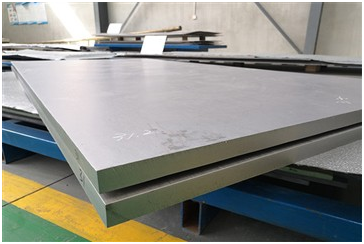
Grade 2 remains a practical titanium plate option when its strength and corrosion performance meet the component requirements. Its familiar forming and fabrication routes can be useful for large plate structures, liners, and fabricated parts.
For FGD applications, Grade 2 may be considered in locations with suitable chemistry, controlled deposits and crevices, and process conditions supported by a corrosion review. It should not be selected just because another part of the same tower uses titanium. The inlet, absorber, outlet duct, and stack liner can experience different temperatures, liquid exposure, and deposits.
A well-supported Grade 2 selection should include documented process chemistry and temperature, a component design that avoids unnecessary stagnant gaps, qualified titanium fabrication procedures, and a purchase specification defining grade, dimensions, inspection, and traceability.
Titanium's corrosion resistance depends on a protective passive oxide film. It performs well in many oxidizing environments, but it is not corrosion-proof. Reducing conditions and some acidic environments can challenge titanium's passivity.
For FGD equipment, the material review should cover more than normal operation. Include cleaning, shutdown, and upset conditions that could change local chemistry. Document cleaning solutions—including organic-acid cleaning where used—reducing or low-oxidizing conditions, stagnant liquid exposure, and local chloride concentration beneath deposits or inside crevices.
Where these conditions are credible, involve a corrosion specialist and consider representative testing. The broad label "wet FGD service" is not enough to establish the suitability of either grade.
Grade 12 is not the only option when crevice-corrosion resistance matters. Grade 7 (UNS R52400) is a palladium-bearing titanium grade, and may be considered for corrosive service where its performance is supported by relevant data. [titanmf]
The practical distinction is that Grade 12 is considered for a combination of higher strength and improved crevice-corrosion performance in hot brines, while Grade 7 is considered for its corrosion-resistance characteristics. Do not select Grade 7 expecting higher strength than Grade 2; confirm mechanical properties and alloy chemistry against the applicable product specification and certified test report.
Palladium-bearing grades can carry a cost premium. Where strongly acidic or reducing chloride service is credible, compare Grade 7, Grade 12, and other suitable candidates using data relevant to the actual chemistry, temperature, and component geometry. The right choice depends on service conditions, fabrication, availability, and lifecycle cost—not on grade name alone.
Selecting a plate grade does not settle the corrosion performance of a fabricated component. Engineers must consider the weld metal and heat-affected zone as well as the parent plate. Titanium welding requires qualified procedures and effective shielding against atmospheric contamination while the metal is hot.
For Grade 12, identify the base-metal grade in fabrication documents and have the welding engineer approve the filler metal and procedure for the joint design, thickness, and service environment. Do not assume that a filler used for Grade 2 is automatically appropriate for Grade 12—or that a nominally matching filler alone proves a joint suitable.
Before fabrication, agree on procedure qualification, shielding and cleanliness controls, inspection criteria, repair acceptance, and any project-specific corrosion evaluation of weldments.
Titanium can absorb hydrogen in certain environments. Excessive hydrogen uptake can lead to hydride formation and reduced ductility. For FGD equipment, assess credible hydrogen-generation or hydrogen-pickup pathways rather than focusing only on acidic cleaning chemistry.
Depending on the system, review reducing or acidic solutions, elevated-temperature or high-pressure water exposure, cathodic protection, and galvanic contact with other metals. Deposits and crevices can create local conditions different from the bulk process. Risk depends on chemistry, temperature, potential, exposure time, stress, and material condition.
Do not treat a single temperature—such as 70°C—as a universal threshold for hydrogen damage. If hydrogen pickup is credible, document it in the materials and equipment-integrity review and define appropriate operating controls, inspection, or testing with a qualified specialist.
List the absorber, inlet and quench sections, outlet duct, stack liner, supports, connections, and wet/dry transition areas. For each surface, record whether it contacts gas, condensate, slurry, deposits, wash water, or cleaning solution. Conditions can differ substantially from one location to another.
Collect temperature, pH, chloride concentration, oxidizing or reducing conditions, solids content, cleaning chemicals, startup and shutdown conditions, and outage exposure. Identify missing data and resolve important gaps before finalizing the material specification.
Use process data to determine which grades merit engineering review. Grade 2 is a candidate where its corrosion performance and strength are adequate. Grade 12 deserves particular evaluation for hot-chloride conditions involving crevices or deposits. Consider other corrosion-resistant grades when the chemistry warrants comparison.
Set plate thickness through structural calculations and the applicable construction code. For pressure-retaining parts, determine allowable stress from the governing code's material and temperature tables. Do not use minimum tensile strength as a substitute for design stress.
Include forming radii, cold-work limits, springback control, weld filler selection, inspection, and repair requirements in the same review.
State the grade, product standard and edition, dimensions and tolerances, product condition, surface requirements, inspection scope, test documentation, traceability, marking, and packaging. Require appropriate certification and maintain traceability if plates are cut or fabricated before final inspection.
A sound comparison considers more than price per kilogram. Include forming and welding costs, inspection, installation access, maintenance, and the consequence of replacing a difficult-to-reach component.
Ask suppliers to quote against the same scope: grade and standard, plate dimensions, inspection and documentation, traceability, packaging, delivery, and any fabrication support. Compare the installed and maintainable solution rather than material price alone. A higher initial material cost can be justified only when the engineering case supports it.
No. Grade 12 has higher reference minimum strength and is a strong candidate for hot-chloride crevice-corrosion concerns. Grade 2 can be appropriate where the chemistry and component design support it. Selection depends on the specific service zone, not the tower name.
The reference minimums in this comparison are 483 MPa for Grade 12 and 345 MPa for Grade 2, about a 40% difference. Confirm values against the applicable specification edition, product form, thickness, and certified test report before using them in procurement or design.
It may affect forming-process qualification. The reference minimum elongation is 18% for Grade 12 versus 20% for Grade 2. Set forming radii, cold-work limits, and springback controls based on the actual plate thickness, geometry, and fabricator's qualified process.
Grade 7 is a palladium-bearing titanium grade considered for corrosion-resistance requirements. It is not selected as a higher-strength substitute for Grade 2. Compare it with Grade 12 using service-specific corrosion evidence, product requirements, and total cost.
No. Tensile and yield minimums are material acceptance properties, not design allowable stresses. Use the applicable construction-code values for the material, temperature, thickness, and component design.
Specify grade, standard and edition, dimensions and tolerances, inspection and test documentation, surface requirements, traceability, marking, and packaging. For fabricated parts, also define qualified forming and welding procedures, filler selection, and inspection requirements.
1. TIMET, "TIMETAL® Grade 12." Manufacturer datasheet describing Grade 12's composition, higher strength than Grade 2, and hot-brine crevice-corrosion performance. [Open datasheet].
2. Allied Titanium, Specifications Book (2005), Grade 12 composition and minimum tensile-property excerpt. Use the current governing product standard and certified material test report for procurement and design. [Open document].
3. TITAN Metal Fabricators, Technical Titanium Brochure. General information on titanium alloy corrosion behavior. Confirm grade-specific data against the applicable material specification and manufacturer datasheet. [Open brochure].


