

Views: 360 Author: Lasting Titanium Publish Time: 2026-10-19 Origin: Site


Content Menu
>> Potential applications for titanium forgings in oil and gas
>> Selecting a titanium forging grade for the service
>> What ASTM B381 does—and does not—establish
>> Sour-service material selection for titanium forgings
>> Corrosion resistance: strong in many environments, never a blanket guarantee
>> Forging quality: what buyers should specify and verify
>> A practical RFQ checklist for titanium forgings
>> Comparing total cost—not just the quoted price
>> How to qualify a titanium forging supplier
>>> Is ASTM B381 enough to qualify a forging for oil and gas equipment?
>>> Does ASTM B381 automatically include ultrasonic testing?
>>> What should be specified for titanium forgings in H₂S service?
>>> Is titanium immune to corrosion in seawater?
>>> What information should an RFQ include?
>>> How can buyers assess a titanium forging supplier?
>> References
>> Conclusion
Titanium forging for oil and gas equipment can be considered when a component must meet demanding mechanical requirements while operating in a corrosive environment. Titanium and its alloys are often evaluated for selected equipment exposed to seawater or chloride-containing fluids, but suitability depends on the specific grade, service conditions, component design, and project requirements.
Forging shapes heated metal under compressive force to produce a component or near-net-shape blank for further machining. For oilfield applications, the forging itself is only one part of the engineering case. Material selection, heat treatment, inspection, traceability, machining, and final acceptance requirements all matter.
A key distinction for buyers: ASTM B381 is a product specification for titanium and titanium-alloy forgings. It does not, on its own, establish sour-service qualification or automatically satisfy requirements such as ultrasonic examination, API 6A PSL, or project-specific acceptance criteria. [astm]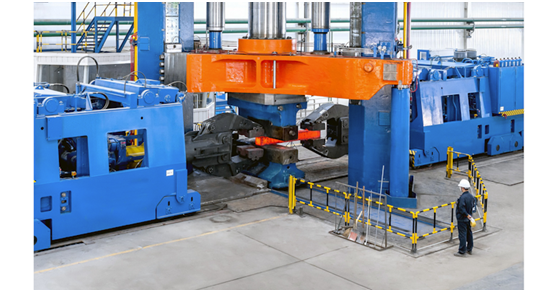
Titanium forgings may be evaluated for selected components where corrosion resistance, mechanical performance, or weight is part of the design case. Potential applications include:
- Valve and pump components: Forged blanks for bodies, bonnets, rings, or other machined parts, when the selected grade and design meet the component requirements.
- Offshore and subsea equipment: Parts exposed to seawater or other corrosive conditions, subject to pressure, fatigue, and project qualification requirements.
- Corrosion-exposed components: Selected parts in chloride-bearing service, following an assessment of the actual environment and component design.
- Custom-engineered parts: Rings, blocks, discs, and other forged forms produced to an agreed drawing and specification.
These are areas for technical evaluation, not blanket recommendations. Begin with the operating envelope: fluid composition, temperature, pressure, flow conditions, exposure duration, and mechanical loading.
There is no single titanium grade that is best for every oilfield application. The required grade and condition should be selected by the responsible engineering team against the design basis, applicable standards, and service environment.
| Procurement factor | What to define |
|---|---|
| Grade and product specification | Exact grade, governing specification, applicable edition, and product condition. ASTM B381 covers titanium and titanium-alloy forgings; verify the required grade and edition for the order. astm |
| Mechanical requirements | Required tensile, yield, elongation, hardness, or other specified properties, including sampling and test direction where applicable. |
| Service conditions | Fluid chemistry, temperature, pressure, exposure, contaminants, and whether the equipment operates in a sour environment. |
| Component design | Drawing and revision, dimensions, tolerances, machining allowance, loading, fatigue considerations, and interfaces with other materials. |
| Inspection and traceability | Required examinations, methods, acceptance criteria, material identification, and documentation. |
Do not select a grade based only on a short product description or a general corrosion claim. Confirm the full specification and product condition with the project's engineering and quality teams.
ASTM B381 is the relevant product specification to consider when purchasing titanium and titanium-alloy forgings. The standard's scope covers multiple grades of annealed titanium and titanium-alloy forgings. [astm]
However, specifying ASTM B381 alone does not establish every requirement for an oil and gas component. It should not be treated as automatic sour-service qualification, nor as automatic inclusion of ultrasonic testing, API 6A Product Specification Level (PSL) requirements, or project-specific acceptance criteria.
For a clear purchase specification, state the requirements separately. Depending on the project, this may include:
- Exact material grade and standard edition.
- Heat-treatment condition and mechanical test requirements.
- Nondestructive examination method, scope, and acceptance criteria.
- Applicable equipment requirements, including API 6A PSL where specified.
- Project inspection, documentation, and acceptance requirements.
Treat each requirement as a separate contractual item. Do not assume that one material standard automatically provides tests or approvals that are not explicitly required.
Where equipment is intended for service containing hydrogen sulfide (H₂S), material selection and qualification should be performed in accordance with the project-specified edition of ANSI/NACE MR0175/ISO 15156, alongside applicable equipment specifications and project requirements.
A general statement such as "NACE compliant" is not enough to establish that a particular forging is suitable. The buyer and supplier should identify the applicable standard edition and confirm how the relevant requirements apply to the specified material, product condition, component, and service environment.
Before placing an order, verify:
- The project's sour-service definition and actual operating conditions.
- The specified titanium grade and product condition.
- Applicable requirements for mechanical properties, hardness, testing, or other acceptance limits.
- The governing standard edition and related equipment specifications.
- Required documentation, inspection, and approval steps.
Sour-service suitability should be determined from the project requirements—not inferred from a generic material description.
Titanium generally offers good corrosion resistance in seawater and many chloride-containing environments. But it should not be described as "corrosion-proof" or as immune to corrosion in every application.
The suitability of a titanium forging depends on the conditions the component will actually encounter. Engineering review should consider fatigue, crevice conditions, hydrogen absorption, welded joints, and galvanic compatibility with connected materials, as well as the complete fluid environment and operating conditions.
For this reason, avoid broad claims such as "will not corrode." Instead, state that the grade and component require evaluation for the intended service. Where the design includes dissimilar materials, joints, or crevices, those features should be included in the assessment.
A forging's shape or surface appearance alone does not prove that it meets the required internal quality, mechanical properties, or service requirements. Define the quality scope before production begins.
1. Specify material and condition. Identify the exact grade, applicable specification and edition, heat-treatment condition, and mechanical test requirements.
2. Define the product scope. Clarify whether the order is for a rough forging, semi-finished component, or fully machined part. Provide a controlled drawing, dimensions, tolerances, and machining allowance.
3. Agree on inspection requirements. State which examinations are required, where they apply, which methods and acceptance criteria govern, and whether witness or hold points are needed.
4. Require traceable documentation. Specify the records required for the supplied material and component. Depending on the contract, this may include chemical analysis, mechanical test results, heat-treatment records, inspection reports, and material identification.
5. Control deviations formally. Require written review and approval by the buyer's authorized technical representative before accepting any deviation from the drawing or specification.
The goal is to make "titanium forging" a verifiable supply requirement, rather than a broad product label.
A detailed request for quotation (RFQ) helps suppliers assess the order and makes technical comparison more reliable. Include:
1. Part identification: Component name, drawing number, revision, and intended equipment.
2. Material requirement: Exact grade, product specification and edition, product condition, and any supplementary requirements.
3. Operating conditions: Fluid composition, temperature, pressure, exposure, and sour-service status where applicable.
4. Dimensions and quantity: Forging type, rough and finished dimensions, tolerances, machining allowance, and order volume.
5. Inspection and testing: Required methods, scope, sampling, acceptance criteria, and witness or hold points.
6. Documentation: Traceability and material, testing, and inspection records required by the order.
7. Delivery instructions: Packaging, marking, destination, schedule, shipping documents, and preservation requirements.
8. Approval process: Any required drawing review, sample approval, qualification records, or pre-production technical review.
Practical tip: Provide the service conditions along with the drawing. A drawing may describe the geometry but not contain enough information to assess the material requirements.
A meaningful comparison should consider the full component and procurement scope, rather than price per kilogram alone. Depending on the application, factors may include forging, heat treatment, testing, machining, inspection, documentation, delivery, and qualification work.
Also account for operational considerations such as maintenance access, replacement logistics, downtime consequences, and compatibility with adjacent materials. These are project-specific considerations, not a guarantee that titanium will always lower lifecycle cost or outlast alternative materials.
For a fair comparison, separate:
- Material and conversion costs: Forging, heat treatment, machining, finishing, and testing.
- Quality and qualification costs: Inspection, documentation, third-party review, and any project-specific qualification.
- Operating considerations: Maintenance plan, access, replacement schedule assumptions, and downtime impact.
- Engineering risks: Design loads, fatigue, joining methods, and compatibility with connected materials.
The best material decision is supported by a documented engineering case, not a general claim that one material is always cheaper or lasts longer.
Supplier qualification should consider technical capability and quality controls as well as price. A supplier's ability to quote a forging does not by itself show that the product will meet the project specification.
Ask prospective suppliers to clarify:
- Product scope: Grades, shapes, sizes, and product conditions offered for the specific RFQ.
- Specification review: How they will address the stated standard, edition, drawing revision, and supplementary requirements.
- Quality and traceability: How product identification, testing, inspection, records, and nonconformances are controlled.
- Documentation: What reports and records will accompany the shipment, and whether representative samples can be reviewed.
- Change control: Who will handle technical questions, deviations, and revisions to the order.
- Delivery requirements: Packaging, marking, shipping documents, schedule assumptions, and destination requirements.
Review the actual purchase specification and inspection records rather than relying on a general certificate or marketing claim. The buyer should define acceptance requirements in the contract and verify the delivered documentation against them.
No. ASTM B381 specifies titanium and titanium-alloy forgings, but it does not automatically establish sour-service qualification or cover every inspection, API 6A PSL, or project acceptance requirement. Specify each applicable requirement in the purchase documents. [astm]
Do not assume that it does. State the required nondestructive examination method, scope, and acceptance criteria in the order and applicable project documents.
Use the project-specified edition of ANSI/NACE MR0175/ISO 15156 for material selection and qualification, alongside applicable equipment and project requirements. Verify the specified material condition and relevant acceptance criteria.
No. Titanium generally has good corrosion resistance in seawater and many chloride-containing environments, but it is not immune to every form of damage. Evaluate the specific service conditions, including fatigue, crevice conditions, hydrogen absorption, welds, and galvanic compatibility.
Include the drawing and revision, exact material specification and edition, service conditions, dimensions and quantity, inspection and testing requirements, acceptance criteria, documentation, and delivery requirements.
Review whether the supplier can address the specified grade and product scope, required inspection and traceability, documentation, change control, and delivery needs. Confirm acceptance requirements in the contract and compare the supplied records with those requirements.
1. ASTM International, [ASTM B381: Standard Specification for Titanium and Titanium Alloy Forgings]. The standard describes its scope as covering annealed titanium and titanium-alloy forgings. [astm]
2. ANSI/NACE MR0175/ISO 15156: Use the project-specified edition and applicable project documents for sour-service material selection and qualification. Confirm the governing version and requirements with the project owner or standards provider before publication or procurement.
3. API 6A PSL and supplementary inspection requirements: Refer to the applicable project specification and contract documents; they are not inferred from ASTM B381 alone.
Titanium forgings may suit selected oil and gas applications, but suitability depends on the actual service environment, grade, design, and project requirements. Specify ASTM B381, sour-service evaluation, inspection, API 6A PSL where applicable, and acceptance criteria as distinct requirements—and verify each against the order documentation.


