

Views: 380 Author: Lasting Titanium Publish Time: 2026-06-20 Origin: Site


Content Menu
● The Science of Titanium Purity: Why It Matters
● Analytical Techniques for Guaranteed Purity
>> 1. Chemical Composition Analysis (ICP-AES/MS)
>> 2. Microstructural Examination (Metallography)
● Data-Driven Assurance: The Role of the MTR
● Expert Perspectives: Beyond Industry Standards
● Checklist for Sourcing Aerospace-Grade Titanium● Conclusion: Trust Through Science
● FAQ
In the high-stakes aerospace industry, where components face extreme thermal stress, cyclic fatigue, and corrosive environments, material purity is not just a specification—it is a critical safety requirement. As a specialist in providing titanium bars for global aerospace partners, Shaanxi Lasting New Material (Lasting Advanced Titanium) Industry Co., Ltd. understands that the structural integrity of an aircraft begins at the atomic level.
This article delves into the physics and chemistry behind titanium purity analysis, detailing why rigorous material control is the bedrock of aerospace reliability and how Lasting Titanium ensures every bar meets these demanding standards.
Titanium is renowned for its high strength-to-weight ratio, yet its performance is heavily dictated by its chemical composition. Even minute levels of interstitial impurities—such as oxygen, nitrogen, hydrogen, and carbon—can drastically alter the metal's mechanical properties [1, 2, 6, 11].
* Oxygen/Nitrogen: Increasing these interstitial elements raises the material's tensile strength but simultaneously compromises its ductility and fracture toughness, leading to brittle failure under stress [2, 6, 7].
* Hydrogen: Excess hydrogen is a known culprit for hydrogen embrittlement, which can cause catastrophic component failure without warning [1, 9].
* Metallic Impurities (e.g., Iron): Uncontrolled iron content can reduce corrosion resistance and affect the metallurgical stability of titanium alloys [1, 2].
To ensure that every titanium bar conforms to aerospace standards (such as AMS 4928), Lasting Titanium employs advanced physics and chemistry-based analytical methodologies to characterize material purity [12, 13, 16].
We utilize Inductively Coupled Plasma (ICP) techniques to determine the elemental composition of our titanium.
* Precision: These methods provide parts-per-million (PPM) accuracy in detecting metallic impurities.
* Consistency: By verifying the concentration of alloying elements (like aluminum and vanadium in Ti-6Al-4V), we ensure that the material's phase balance is optimized for its intended aerospace application [16].
Physics tells us that material properties are a function of microstructure. Our laboratory team prepares samples for high-resolution microscopic observation to ensure:
* Grain Structure: Proper grain size and distribution are critical for fatigue resistance.
* Inclusion Control: We scan for and identify any harmful non-metallic inclusions that could act as crack initiation sites [15].
In the aerospace supply chain, physical bars are only as valuable as the documentation that accompanies them. A Material Test Report (MTR), also known as a Mill Test Report, serves as the "birth certificate" of every titanium bar [13, 14, 18].
At Lasting Titanium, our MTRs provide comprehensive scientific evidence, including:
- Chemical Analysis Results: Confirming the alloy composition falls within strict industry tolerance limits [13, 16].
- Mechanical Test Data: Reporting yield strength, ultimate tensile strength (UTS), and elongation percentage, verified through destructive tensile testing [13, 18].
- Traceability: Binding every test result to the specific heat/lot number, ensuring full accountability from the raw sponge to the finished bar [12, 13, 14].
While industry standards provide the baseline, excellence requires proactive risk management.
- Risk-Based Thinking: We don't just test to pass; we test to understand. By analyzing the thermal history and processing parameters, we mitigate the risk of contamination during melting and forging [9, 13].
- Process Control: Because molten titanium is highly reactive with atmospheric gases (oxygen and nitrogen), our processing takes place under strictly controlled inert or vacuum atmospheres to prevent interstitial pick-up [8, 9].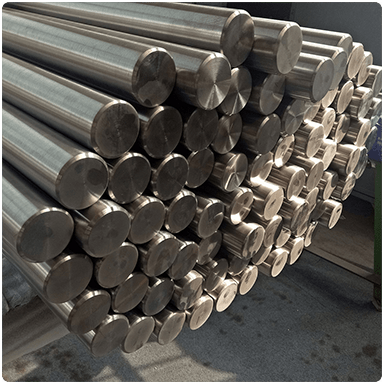
When evaluating potential suppliers, aerospace procurement teams should demand proof of these four pillars of material integrity:
1. Demand Comprehensive MTRs: Never accept a product without a batch-specific MTR that includes chemical and mechanical data [12, 13, 17].
2. Verify Laboratory Accreditation: Ensure the supplier's testing laboratory holds valid ISO or equivalent aerospace-specific quality certifications [16, 17].
3. Check Heat Lot Traceability: Confirm the supplier can map the physical bar back to its original melt heat [12, 13, 18].
4. Confirm Specification Adherence: Ensure the material explicitly meets the required aerospace specifications (e.g., AMS, ASTM, or OEM-specific standards) [13, 19].
Material purity is the silent guardian of aerospace safety. At Shaanxi Lasting New Material (Lasting Advanced Titanium) Industry Co., Ltd., we combine stringent chemical analysis, precise microstructural evaluation, and transparent documentation to guarantee the performance of our titanium products. When you source with us, you are not just acquiring metal; you are securing validated, aerospace-grade reliability.
Need certified aerospace titanium for your next project?
Contact our technical team today to request a quote or to review our latest material test reports. We are ready to support your supply chain with the highest quality titanium materials.
1. [911Metallurgist: How Impurities Affect Titanium Properties]
2. [West Titanium: Effects of Impurities on Ti Plates]
3. [AEETHER: Role of Titanium in Industrial Applications]
4. [Yongshengtai: Impurities and Plate Performance]
5. [Nature: Point Defects and Impurities in Titanium]
6. [Thomasnet: Titanium Properties and Grades]
7. [DTIC: Impurities in Titanium - Phosphorus]
8. [SpaceMatDB: Material Properties and Aerospace Data]
9. [FAA: Manufacturing Process of Premium Quality Titanium (Advisory Circular)]
10. [Xometry: Meaning, History, and Uses of Titanium]
11. [Carpenter Technology: Titanium Alloy Ti 6Al-4V Data Sheet]
12. [Alibaba Seller Blog: Aerospace Titanium Material Selection Guide]
13. [Lasting Titanium: Why AMS 4928 Is The Gold Standard]
14. [OnlineMetals: Material Test Reports (MTR)]
15. [Struers: Metallography of Titanium and Alloys]
16. [6NAPSE Laboratory: Titanium Analysis and Testing]
17. [7Titanium: How to Verify a Real Titanium Factory]
18. [Rolled Alloys: Understanding MTRs]
19. [China Metal Supply: Aerospace Titanium Plate Procurement Guide]
1. How do impurities like oxygen and nitrogen affect titanium bars?
High levels of interstitial impurities like oxygen and nitrogen increase tensile strength but significantly reduce ductility and fracture toughness, making the titanium more brittle and prone to failure under fatigue.
2. What is an MTR, and why is it mandatory for aerospace titanium?
An MTR (Material Test Report) is the "birth certificate" of metal. In aerospace, it is mandatory because it provides scientific, lab-verified proof that the material's chemical composition and mechanical properties meet specific regulatory and safety standards.
3. How does Lasting Titanium prevent impurity contamination?
We control the melting and processing environment using vacuum or inert-gas atmospheres to prevent the reactive titanium from picking up atmospheric gases like oxygen and nitrogen during production.
4. Can you analyze metallic impurities in titanium?
Yes. We use advanced analytical techniques such as Inductively Coupled Plasma (ICP) spectroscopy to detect and quantify metallic impurities at parts-per-million (PPM) levels to ensure alloy purity.
5. What is the difference between chemical composition and mechanical testing?
Chemical composition testing identifies the elemental makeup (e.g., % of Al, V, Fe) to confirm the alloy grade, while mechanical testing (e.g., tensile tests) verifies that the physical metal behaves correctly under stress, heat, and strain.


