
Views: 218 Author: Site Editor Publish Time: 2026-02-15 Origin: Site


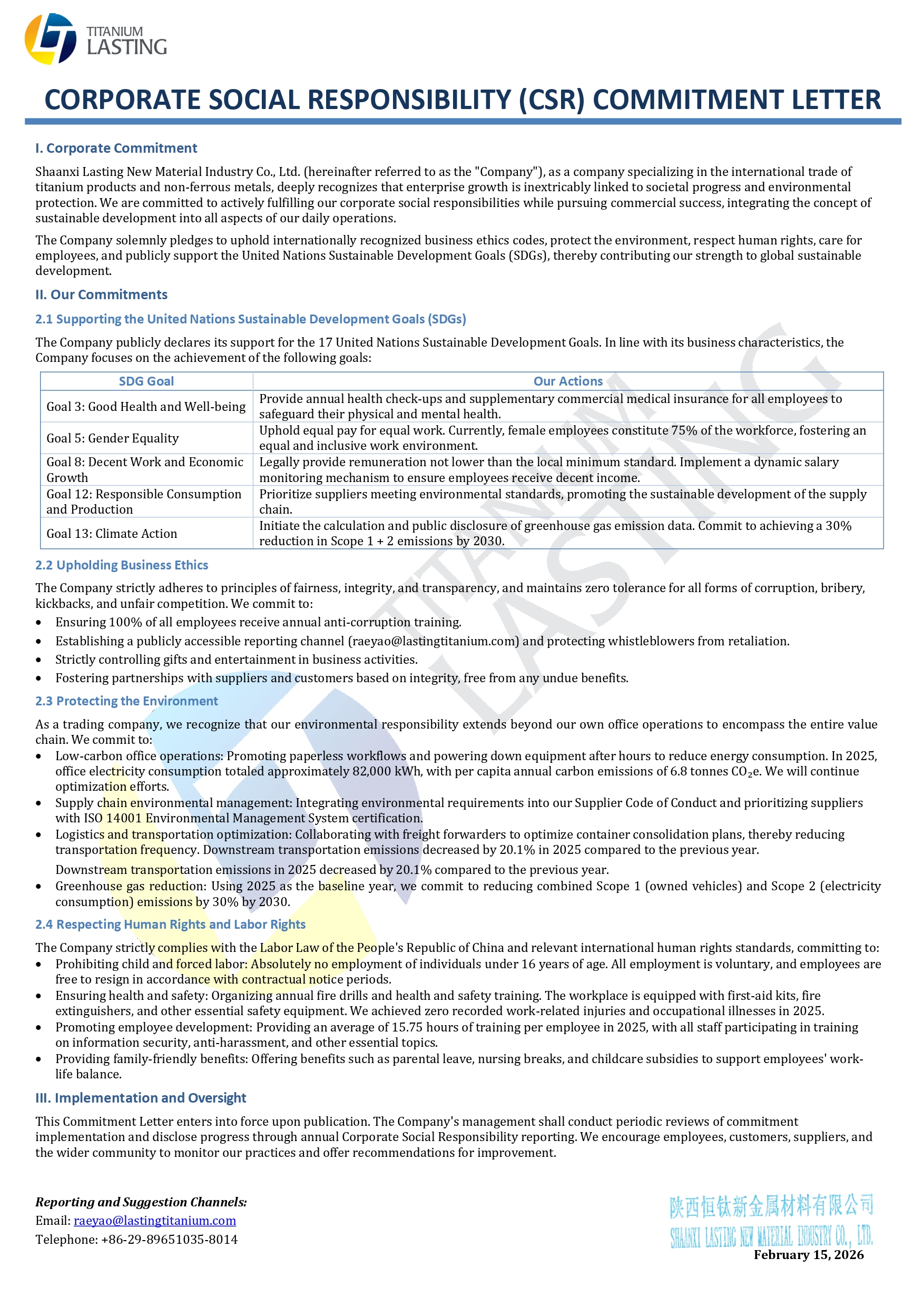
Marking a new chapter in our corporate responsibility, Lasting Titanium unveiled its inaugural Greenhouse Gas Emission Reduction Commitment in February 2026. This public announcement represents our formal pledge to address climate change through concrete, accountable actions.

Titanium pipe for offshore equipment must be selected against the actual service environment, design loads and project specifications. Compare Grades 2, 7 and 12 based on engineering evidence—not a universal ranking. Specify seamless or welded pipe under the applicable ASTM standard, calculate wall thickness with all required allowances and tolerances, and verify documentation, fabrication and inspection requirements before ordering.

*Titanium strip coil for heat-exchanger fabrication—feedstock for plate blanks and formed components, not a substitute for finished coil tubing or finished heat-exchanger plates.***Titanium coil for heat exchangers** can refer to two different products: finished coil tubing used in a heat exchanger,

ASTM B265 defines requirements for annealed titanium and titanium alloy strip, sheet, and plate—but buyers should specify product form, dimensions, tolerances, grade, condition, testing, and documentation in the order. Choose grades for the application, verify chemistry and traceability, and confirm hydrogen limits against the applicable standard edition.

Titanium sheet for medical devices must be specified by exact grade, standard, product form, and intended use. ASTM F67 and ISO 5832-2 cover implant materials; ASTM B265 is a general sheet specification, not an automatic implant substitute. Verify lot traceability, testing, processing, and device-level requirements.

Grade 2 titanium sheet is a commercially pure material used in chemical-processing equipment when its corrosion resistance, formability, and strength suit the service conditions. Confirm process chemistry, temperature, dimensions, ASTM B265 requirements, traceability, and fabrication needs before ordering. Send your specifications to Shannxi Lasting for a project-specific quotation.

Compare Grade 2 and Grade 12 titanium plates for wet FGD towers. Review strength, elongation, hot-chloride crevice-corrosion considerations, Grade 7 as an alternative, welding and hydrogen risks, plus a practical checklist for material selection and procurement.

Titanium is becoming an increasingly important material in the food industry, especially for **titanium cookware, food-processing equipment, storage vessels, professional kitchen products, and specialized food-contact components**. Its combination of low density, high strength, corrosion resistance,

Learn how to verify a titanium manufacturer’s AS9100 and PED certification, review key documents, confirm product traceability, identify certification red flags, and choose a reliable supplier for aerospace, pressure equipment, and industrial applications.

Ti-6Al-4V ELI has lower interstitial elements, offering better toughness and ductility. It is widely preferred for surgical implants, subject to ASTM F136 and device-specific validation.

When sourcing **titanium bar, titanium alloy components, or CNC-machined titanium parts**, selecting a supplier based only on price, equipment lists, or attractive product photographs can create serious quality and delivery risks. A qualified **titanium supplier** must demonstrate control over the c
Medical titanium requires more than the correct grade. Suppliers must provide controlled manufacturing, accurate testing, complete heat-lot traceability, reliable documentation, and responsive quality support. By aligning material control with ISO 13485 expectations, Lasting Advanced Titanium helps medical-device manufacturers reduce supply-chain risk and build confidence in titanium bars, rods, wires, plates, and custom components.
Titanium coils improve the corrosion resistance, durability, and heat-transfer reliability of large-scale plate heat exchangers. This article covers titanium grades, coil design, seawater and chemical applications, welding, inspection, quality control, and supplier selection for efficient, long-term industrial performance.

Shaanxi Lasting is positioned as a reliable partner for corrosion-resistant metals because it combines a broad titanium and specialty-metal portfolio with manufacturing coordination, international-standard awareness, quality documentation, export experience, and custom supply support. For overseas brands, wholesalers, and manufacturers, the strongest partnership begins with a complete technical specification and continues through traceable production, inspection, packaging, and delivery. When you need dependable titanium bar or other corrosion-resistant metals, Shaanxi Lasting can help turn a material requirement into a controlled and export-ready supply solution.

Grade 1 is best for maximum formability, Grade 2 is the most balanced industrial option, Grade 3 provides additional strength, and Grade 4 offers the highest strength among CP titanium grades. The best choice is not the strongest grade—it is the grade that safely meets the application while controlling manufacturing and procurement risk.

Titanium forging refines microstructure by combining controlled deformation, thermal processing, phase transformation, heat treatment, and inspection.** The result can be a more uniform and reliable material structure for components exposed to repeated loading, crack-growth risk, corrosion, and demanding safety requirements. The most important lesson is that forging quality cannot be judged by shape or tensile strength alone. A reliable titanium forging requires control of **billet chemistry, deformation throughout the section, forging temperature, grain flow, phase morphology, heat treatment, surface condition, internal soundness, and traceability.

After approximately three decades of industrial development and marine application experience, titanium remains one of the most dependable material options for seawater-facing equipment. Its stable passive oxide film, high corrosion resistance, relatively low density, and strong specific strength make it valuable for heat exchangers, desalination systems, offshore equipment, subsea components, fasteners, pump parts, and machined titanium bar applications. The most important lesson is that long service life does not come from alloy selection alone. Titanium must be supported by correct product specifications, clean fabrication, appropriate welding, galvanic isolation, controlled cathodic protection, sound joint design, regular inspection, and complete traceability. When these factors are managed together, titanium can support a 30-year marine engineering objective and reduce the maintenance and replacement risks associated with more conventional materials.

Compare standard and custom titanium bar lengths and diameters. This guide explains Grade 2, Grade 5, ASTM B348, tolerances, surface finishes, cutting options, machining efficiency, lead times, quality documentation, and how Lasting Advanced Titanium supports global titanium bar buyers.

Learn how to read MTCs for titanium forgings. This practical guide explains grade, ASTM B381, heat numbers, chemistry, tensile results, heat treatment, dimensions, NDE, traceability, common certificate errors, and quality checks for international buyers sourcing titanium rings, discs, bars, blocks, and custom forgings.

Titanium sheets are a strong material for hydrogen fuel-cell bipolar plates because they combine corrosion resistance, high strength, low weight, dimensional stability, and precision-forming potential. Learn about titanium grades, conductive coatings, manufacturing, quality control, testing, and global sourcing from Lasting Advanced Titanium.

Custom titanium fittings for complex piping, including elbows, tees, reducers, and fabricated branches. Learn about titanium grades, ASTM B363, ASME B16.9, manufacturing, welding, inspection, applications, and how Lasting Advanced Titanium supports global industrial buyers.


