

Views: 315 Author: Lasting Titanium Publish Time: 2026-03-16 Origin: Site


Content Menu
>> Metallurgical Standards and Grade Specification
>> Biocompatibility and Surface Integrity
>> Mechanical Property Evaluation for Clinical Performance
>> Manufacturing and Processing Considerations
>> Economic and Supply Chain Sustainability
>> Emerging Trends in Medical Titanium
>> Related Questions and Answers
The selection of titanium sheet for medical device manufacturing is a critical engineering decision that directly influences the safety, efficacy, and long-term clinical performance of implants. As a professional in the titanium export industry, I understand that for industry peers, materials scientists, and medical device engineers, the decision-making process transcends basic procurement. It requires a profound, granular understanding of metallurgy, mechanical behavior under physiological conditions, and the intricacies of regulatory compliance. This comprehensive guide provides an in-depth analysis of the technical parameters essential for selecting medical-grade titanium sheet.
The foundational step in the material selection process is absolute compliance with internationally recognized standards. The industry relies heavily on ASTM specifications to ensure that chemical composition and mechanical properties are consistent across every heat and production batch.
For unalloyed titanium, often referred to as Commercially Pure (CP) titanium, the standard ASTM F67 is the primary baseline. This specification covers Grades 1 through 4, which are categorized by their oxygen, nitrogen, and iron content. These interstitial elements act as solid-solution strengtheners; as the grade number increases, the mechanical strength increases while ductility decreases. These grades offer exceptional corrosion resistance and a neutral biological profile, making them ideal for applications that prioritize biological integration and moderate mechanical requirements, such as craniomaxillofacial plates, dental mesh, or pace-maker housings.
Conversely, for high-stress, load-bearing applications such as spinal fusion cages or internal fixation devices, ASTM F136 or ISO 5832-3 compliant alloys are mandatory. Grade 5 (Ti-6Al-4V) and its Extra Low Interstitial (ELI) variant, Grade 23, are the undisputed industry workhorses. Grade 23 is particularly favored for critical, long-term implantable devices because the lower levels of oxygen, nitrogen, and carbon significantly enhance fracture toughness and, most importantly, fatigue resistance. In the competitive landscape of implant manufacturing, the shift toward Grade 23 ELI has become the gold standard to mitigate the risk of catastrophic failure in high-load scenarios.
Biocompatibility is the defining characteristic of medical-grade titanium. The spontaneous formation of a dense, stable, and chemically inert titanium dioxide layer on the material surface—often only a few nanometers thick—is what grants titanium its unparalleled corrosion resistance within the harsh, chloride-rich human physiological environment.
When selecting titanium sheet, manufacturers must critically evaluate surface finish requirements alongside bulk properties. The surface morphology, whether treated via acid etching, grit blasting, or plasma spraying, directly dictates cellular adhesion, proliferation, and the subsequent rate of osseointegration. The manufacturing processes for these sheets—including vacuum annealing and precision cold rolling—must be strictly controlled to prevent the inclusion of "alpha-case" or surface contaminants. Any residual lubricant or processing debris can trigger inflammatory responses or compromise the integrity of the protective oxide layer. Strict material traceability, from the initial Kroll-process titanium sponge to the final sheet, is non-negotiable for medical device OEMs to satisfy global regulatory bodies like the FDA or EMA.
The mechanical performance of titanium sheet is evaluated through a spectrum of metrics: yield strength, tensile strength, elongation, and modulus of elasticity. These properties must be meticulously matched to the anatomical environment of the device.
A persistent challenge in orthopedic implants is "stress shielding." This occurs when the elastic modulus of the metallic implant significantly exceeds that of the surrounding cortical bone, causing the implant to bear the majority of the load. This prevents the bone from receiving necessary mechanical stimuli, leading to bone resorption.
To combat this, the industry is increasingly exploring beta-type titanium alloys, such as Ti-15Mo or Ti-Nb-Zr-Ta systems. Unlike the traditional alpha-beta Ti-6Al-4V, these beta alloys possess a lower elastic modulus that is much closer to that of human bone, significantly reducing stress shielding. Furthermore, the development of porous titanium structures—often manufactured using additive techniques or sheet-layering—allows for bone ingrowth, creating a mechanical interlock that enhances device fixation and promotes long-term stability.
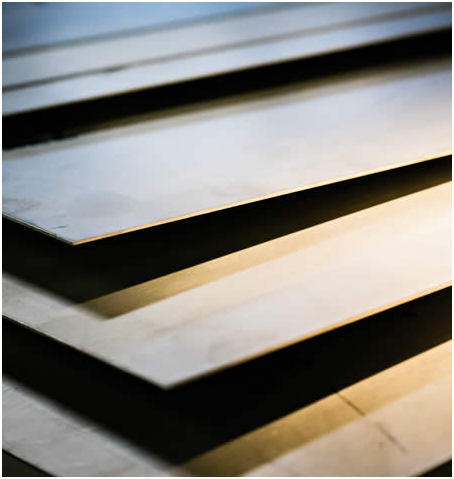
Selecting the right titanium sheet also involves evaluating how the material will respond to secondary fabrication processes. Whether the sheet is destined for laser cutting, photochemical etching, or high-speed CNC machining, the thermal properties of the material are significant.
Titanium alloys have lower thermal conductivity compared to stainless steel or cobalt-chrome. This means that heat generated at the cutting zone is not efficiently dissipated by the material, but rather concentrated at the tool-workpiece interface. This necessitates the use of high-pressure, specialized coolants and high-performance carbide or diamond-coated tools. Inadequate thermal management during processing can lead to the formation of a brittle, oxidized surface layer known as the alpha-case. This layer is detrimental; it acts as a stress riser and a crack initiator, which is unacceptable for devices subject to cyclic fatigue, such as orthopedic bone screws or plates.
Furthermore, thickness tolerance and surface flatness are paramount for high-precision components. Even minor deviations in gauge control can lead to inconsistent photochemical etching results or poor dimensional accuracy in stamped parts. A supplier who provides "medical-grade" tolerance specifications—which are significantly tighter than standard industrial requirements—is an asset that minimizes production scrap and optimizes cycle times.
While technical performance is the primary gatekeeper, cost and supply chain reliability remain critical to project success. Medical device manufacturers require a stable, repeatable supply of materials that meet batch-to-batch consistency for regulatory validation.
A reputable supplier must operate under an ISO 13485 quality management system. This ensures that the material testing, handling, and logistics meet the stringent demands of the medical device sector. Detailed Material Test Reports (MTRs) are the lifeblood of this process. They provide proof of compliance with ASTM chemical composition limits (e.g., maximum limits for oxygen, carbon, and iron in Grade 23). Understanding the market dynamics of titanium sponge and the strategic capacity of the supply chain is essential for long-term production planning. In the current global climate, manufacturers are increasingly moving away from transactional procurement toward strategic, long-term partnerships with titanium mills that prioritize transparency, traceability, and technical support.
The horizon of medical titanium is rapidly evolving. Beyond the traditional alpha-beta alloys, we are witnessing a surge in research and adoption of additive manufacturing (AM) compatible sheets and foils. These materials are engineered with specific microstructures to handle the rapid cooling cycles of laser-based fabrication.
Moreover, the integration of surface functionalization—where the titanium surface is chemically modified to release antimicrobial ions or promote specific protein signaling—is transitioning from lab-scale research to clinical practice. By selecting sheets that are optimized for these secondary surface modifications, device manufacturers can push the boundaries of what is possible in implantable medicine, moving toward "smart" devices that actively interact with the patient's biology to accelerate recovery.
Q: Why is Grade 23 (Ti-6Al-4V ELI) specifically preferred over Grade 5 for critical spinal and orthopedic implants?
A: Grade 23 contains significantly lower levels of interstitial elements like oxygen, nitrogen, and iron. These impurities, while present in Grade 5, can act as embrittling agents. By strictly limiting these, Grade 23 gains superior fracture toughness and enhanced fatigue resistance, which is essential for implants subjected to millions of weight-bearing cycles in the human body.
Q: How does surface finish modification influence the long-term success of an orthopedic implant?
A: Surface finish dictates the biological response at the implant-tissue interface. A controlled porous or roughened surface facilitates osseointegration by allowing bone cells to penetrate and lock into the structure, whereas a polished, smooth surface is often required for articulating components to minimize frictional wear and debris generation.
Q: What is the significance of the titanium dioxide layer in medical applications?
A: This naturally occurring, highly stable, and inert oxide layer acts as a passivation barrier. It prevents the underlying metal from reacting with the oxygen and chlorides in physiological fluids. This prevents corrosion and, critically, inhibits the leaching of metal ions into the surrounding patient tissue, which could otherwise lead to sensitivity or long-term clinical complications.
Q: Why are beta-type titanium alloys like Ti-15Mo receiving so much attention in research circles?
A: The primary driver is the reduction of the elastic modulus. Traditional medical titanium alloys are much stiffer than bone, which causes "stress shielding" and subsequent bone loss. Beta alloys offer a modulus closer to that of bone, allowing for more natural load distribution and improved bone health around the implant.
Q: What specific information should I demand in a Material Test Report (MTR) to ensure regulatory compliance?
A: A valid MTR must include the full chemical composition analysis (including trace elements), mechanical test results (yield, tensile, elongation), evidence of thermal treatment (e.g., vacuum annealed), and the specific ASTM standard compliance. It must also feature a unique heat number to ensure full traceability back to the original titanium sponge production batch.


