

Views: 356 Author: Lasting titanium Publish Time: 2025-05-29 Origin: Site


Content Menu
● Overview of ASTM B381 Specification
● Manufacturing Process of Titanium Grade 2 Discs
● Chemical Composition of Titanium Grade 2
● Mechanical Properties of Titanium Grade 2 Discs
● Corrosion Resistance and Durability
● Common Applications of Titanium Grade 2 Discs
>> Chemical Processing Industry
>> Aerospace
● Advantages Over Other Titanium Grades
● Handling, Maintenance, and Inspection
● Frequently Asked Questions (FAQs)
Titanium Grade 2 is a commercially pure titanium alloy known for its outstanding corrosion resistance combined with moderate strength and excellent ductility. It contains small, controlled amounts of oxygen, nitrogen, hydrogen, and iron which enhance its mechanical properties without compromising its resistance to corrosive environments.
This grade is often described as the “workhorse” of commercially pure titanium alloys due to its balance of strength and flexibility. It is widely used in applications where durability and resistance to harsh chemicals or marine atmospheres are crucial. Compared to other commercially pure grades, it offers slightly higher strength than Grade 1 and better corrosion resistance than Grade 3, making it the most popular choice for many industrial and medical uses.
Titanium Grade 2's excellent weldability and formability also make it easier to fabricate complex parts, which is a significant advantage in manufacturing processes.
ASTM B381 is a comprehensive specification that governs the production of annealed titanium and titanium alloy forgings, including discs, bars, and billets. It defines strict chemical composition limits, mechanical property requirements, and quality assurance protocols for 39 different titanium grades.
Titanium Grade 2 corresponds to Grade F-2 (and F-2H for higher strength variants) within ASTM B381. The specification mandates:
- Chemical Composition: Precise limits on carbon, oxygen, nitrogen, hydrogen, and iron to ensure purity and performance consistency.
- Mechanical Properties: Minimum tensile strength of 345 MPa (50 ksi), yield strength of 275 MPa (40 ksi), elongation minimum of 20%, and reduction of area minimum of 30%.
- Testing and Inspection: Includes nondestructive testing methods such as ultrasonic and dye penetrant inspections, chemical analysis, and mechanical testing to verify compliance.
ASTM B381 ensures that titanium discs manufactured to its standards provide reliable performance in critical applications, meeting the demands of industries where failure is not an option.
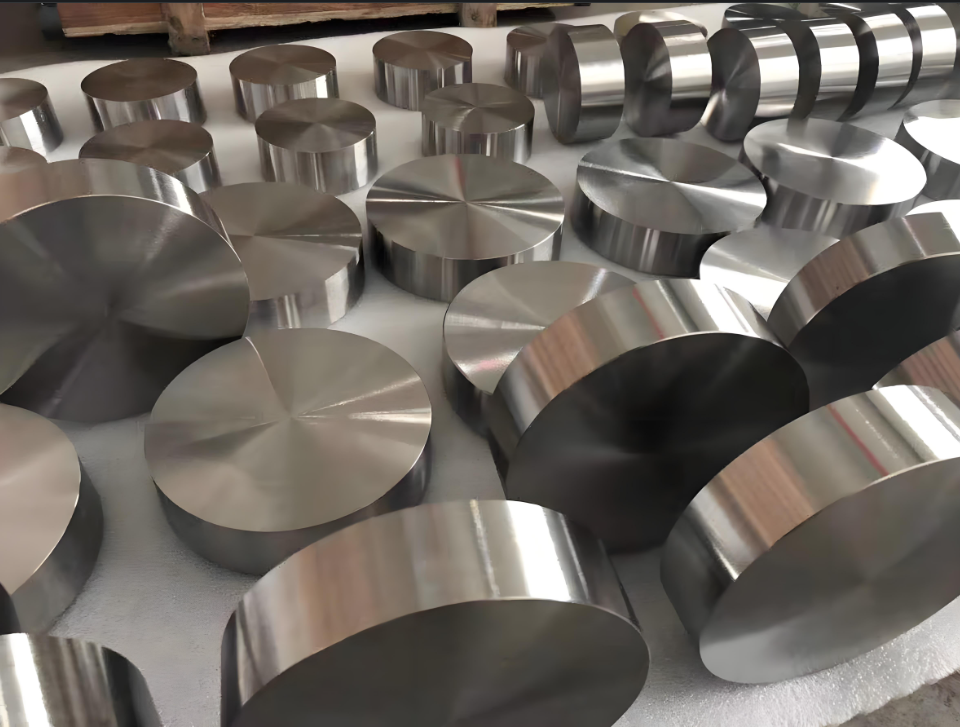
Titanium Grade 2 discs are typically produced by forging titanium billets under carefully controlled temperature and pressure conditions. Forging refines the microstructure of the titanium, enhancing strength, toughness, and fatigue resistance.
After forging, the discs undergo annealing heat treatment. Annealing relieves internal stresses induced during forging and improves ductility, making the discs easier to machine and form without cracking. The annealed condition is critical to achieving the mechanical properties specified by ASTM B381.
Once annealed, the discs are machined to precise dimensions and surface finishes. High-precision CNC machining ensures tight tolerances and smooth surfaces, which are essential for applications requiring exact fits and optimal performance.
Throughout the manufacturing process, rigorous quality controls are applied. Chemical composition is verified using spectroscopy, mechanical properties are tested through tensile and hardness testing, and nondestructive testing methods such as ultrasonic or dye penetrant inspections detect surface and internal defects.
These comprehensive quality assurance measures guarantee that each titanium disc meets or exceeds industry standards.
The chemical composition of Titanium Grade 2 is carefully controlled to balance strength and corrosion resistance. It consists primarily of commercially pure titanium with the following maximum impurity limits:
- Carbon: 0.08%
- Oxygen: 0.25%
- Nitrogen: 0.03%
- Hydrogen: 0.015%
- Iron: 0.30%
- Titanium: Balance
Oxygen content plays a significant role in strengthening the alloy but must be limited to preserve ductility and corrosion resistance. The low levels of nitrogen and hydrogen prevent embrittlement, while iron enhances mechanical strength without compromising corrosion resistance.
This composition results in a material that performs exceptionally well in oxidizing environments such as seawater, acidic atmospheres, and many industrial chemical exposures.
Titanium Grade 2 discs exhibit a well-rounded set of mechanical properties:
- Tensile Strength: Minimum 345 MPa (50 ksi)
- Yield Strength: Minimum 275 MPa (40 ksi)
- Elongation: Minimum 20%, indicating good ductility
- Reduction of Area: Minimum 30%, showing toughness
- Hardness: Approximately 150 HV
These properties ensure that the discs can withstand mechanical stresses, resist deformation, and maintain structural integrity over long service periods.
The combination of strength and ductility makes Grade 2 titanium discs suitable for components subjected to dynamic loads and pressure fluctuations.
Titanium Grade 2 is renowned for its exceptional corrosion resistance. It naturally forms a thin, adherent oxide film on its surface that acts as a protective barrier against corrosive agents. This oxide layer is self-healing, meaning it can repair itself if damaged, maintaining continuous protection.
This corrosion resistance extends to a wide range of aggressive environments, including seawater, chlorine-containing atmospheres, acidic solutions, and industrial chemicals. This makes Titanium Grade 2 discs ideal for use in marine engineering, chemical processing, and power generation where corrosion is a major concern.
The durability provided by this corrosion resistance reduces maintenance requirements and extends the operational life of components made from Grade 2 titanium.
Titanium Grade 2 discs are widely used in heat exchangers, reactors, and piping systems exposed to corrosive chemicals. Their resistance to pitting and crevice corrosion ensures system integrity and safety in harsh chemical environments.
The excellent resistance to seawater corrosion makes Grade 2 titanium discs ideal for seawater cooling systems, desalination plants, and offshore platforms. Their lightweight nature also helps reduce structural loads.
Due to their biocompatibility and corrosion resistance, Grade 2 titanium discs are used in implants, surgical instruments, and prosthetics. They do not cause adverse reactions in the body and resist degradation from bodily fluids.
Grade 2 titanium discs are used in structural components and fasteners where weight reduction and corrosion resistance are critical for performance and safety.
Titanium discs are employed in turbine components and heat exchangers that require durability under high temperature and corrosive conditions.
Compared to other titanium grades, Grade 2 offers an excellent balance of corrosion resistance and mechanical strength at a relatively affordable cost. For example:
- Grade 5 (Ti-6Al-4V): Offers higher strength but is less corrosion resistant and significantly more expensive.
- Grade 7: Enhanced corrosion resistance due to palladium addition but at a higher price point.
- Grade 2: Provides excellent corrosion resistance, moderate strength, and cost efficiency.
This balance makes Grade 2 titanium discs the preferred choice for many industrial and medical applications where both performance and cost are critical.
Titanium Grade 2 discs require minimal maintenance due to their corrosion resistance. However, proper handling is essential to avoid contamination that could impair the protective oxide layer. Avoid contact with iron or other metals during storage and fabrication to prevent galvanic corrosion.
Regular inspections using nondestructive testing methods such as ultrasonic or dye penetrant testing help detect surface or internal defects, ensuring ongoing reliability and safety.
Q1: What industries commonly use Titanium Grade 2 discs?
A1: Chemical processing, marine, medical, aerospace, and power generation industries widely use these discs.
Q2: How does ASTM B381 ensure quality in Titanium Grade 2 discs?
A2: ASTM B381 specifies chemical composition, mechanical properties, and testing requirements to guarantee consistent quality.
Q3: Can Titanium Grade 2 discs be welded?
A3: Yes, they have good weldability when proper techniques are applied.
Q4: What makes Titanium Grade 2 corrosion resistant?
A4: A stable, self-healing oxide layer on the surface protects against corrosive environments.
Q5: How does Titanium Grade 2 compare to stainless steel in marine applications?
A5: Titanium Grade 2 offers superior corrosion resistance and longer service life in seawater environments.
Titanium Grade 2 discs manufactured according to ASTM B381 provide an excellent combination of corrosion resistance, mechanical strength, and versatility. Their widespread use across chemical, marine, medical, aerospace, and power industries highlights their reliability and cost-effectiveness. The ASTM B381 standard ensures consistent quality, making Titanium Grade 2 discs a trusted material choice for demanding applications.


