

Views: 298 Author: Lasting Titanium Publish Time: 2026-05-23 Origin: Site


Content Menu
● Decoding REACH: More Than Just Red Tape
● The Strategic Importance of Compliance for Titanium Exporters
● Navigating the SVHC Candidate List
● Technical Rigor: Our Approach to Compliance
● Practical Steps for Importers and OEMs
● Overcoming Common Misconceptions
● Frequently Asked Questions (FAQ)
For global manufacturers and distributors, the European Union (EU) represents one of the most lucrative yet technically demanding markets in the world. When exporting high-performance materials such as titanium bars, plates, and forged components, navigating the regulatory maze is not just a legal obligation—it is a competitive necessity. At the heart of this regulatory framework lies REACH (Registration, Evaluation, Authorisation, and Restriction of Chemicals). For a specialized supplier like Shaanxi Lasting New Material (Lasting Advanced Titanium) Industry Co., Ltd., ensuring full REACH compliance is the cornerstone of our ability to provide seamless, risk-free titanium solutions to our international partners.
REACH is a far-reaching regulation aimed at improving the protection of human health and the environment from the risks that can be posed by chemicals. While often misunderstood by industrial exporters as a simple administrative hurdle, it is, in reality, a comprehensive chemical management strategy. For companies exporting titanium products—including rods, sheets, and complex forgings—the focus shifts from the bulk metal to the chemical composition of the alloys and any potential hazardous substances contained within them.
Under REACH, titanium bars and plates are typically classified as "articles." While articles themselves generally do not require substance registration, the alloys and trace elements within them must be assessed against the SVHC (Substance of Very High Concern) Candidate List. Ignoring these requirements can lead to delayed shipments, hefty fines, and the potential for a complete ban from the European market.
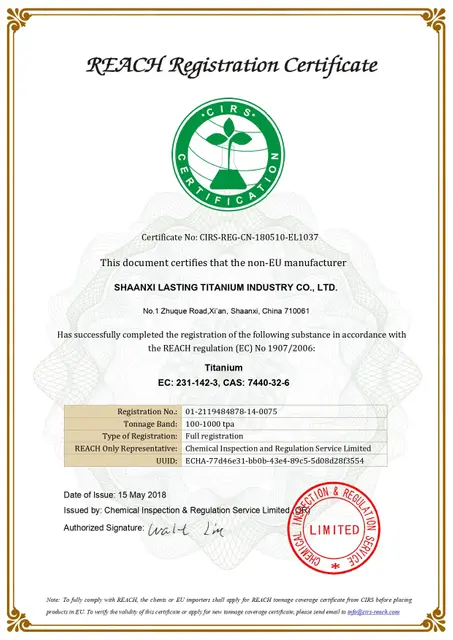
Why should an OEM or a wholesaler care about their supplier's REACH status? The answer lies in supply chain security and liability protection.
* Market Continuity: REACH is enforced by national authorities across the EU. Non-compliant products can be seized at customs, leading to project shutdowns and massive financial losses for your production lines.
* Liability Mitigation: Under the "No Data, No Market" principle, the responsibility for chemical safety lies with the manufacturer and importer. Partnering with a supplier like Shaanxi Lasting New Material, which proactively manages REACH compliance, shields your brand from unexpected legal exposure.
* Enhanced Competitiveness: European buyers are increasingly prioritizing suppliers who can provide transparent, audit-ready compliance documentation. Demonstrating REACH adherence is a clear marker of a professional, globally-minded enterprise.
A critical component of REACH compliance for titanium alloys (such as Ti-6Al-4V or Grade 5) is the ongoing monitoring of the SVHC Candidate List. As the European Chemicals Agency (ECHA) updates this list, manufacturers must ensure that their alloys do not contain any restricted substances above the 0.1% weight-by-weight threshold.
| Action Item | Frequency | Importance |
|---|---|---|
| Supply Chain Audits | Quarterly | Ensures no restricted substances enter the manufacturing process. |
| Material Testing (ICP-OES) | Per Batch | Verifies chemical purity and composition for compliance. |
| SCIP Notification | Mandatory | Required if an article contains SVHCs above 0.1% concentration. |
| Documentation Review | Annual | Keeps technical files updated with the latest ECHA amendments. |
At Shaanxi Lasting New Material (Lasting Advanced Titanium) Industry Co., Ltd., we view compliance as a technical discipline rather than an administrative task. Our approach combines rigorous metallurgical testing with proactive regulatory tracking:
1. Material Source Verification: We vet every raw material supplier, ensuring that they share our commitment to ECHA standards.
2. Advanced Analytical Testing: Our laboratory utilizes Inductively Coupled Plasma Optical Emission Spectroscopy (ICP-OES) to verify that trace elements in our titanium rods and plates are well within the permissible limits set by EU regulations.
3. Active Regulatory Monitoring: Our dedicated compliance team tracks updates from the European Chemicals Agency in real-time, ensuring our technical files are always one step ahead of changing requirements.
If you are a brand owner or wholesaler, how can you ensure your titanium supply chain is truly REACH compliant? Follow this checklist to mitigate your risks:
* Request a Declaration of Compliance: Always obtain a formal, signed REACH declaration from your supplier that specifically references the latest SVHC Candidate List.
* Verify Material Test Reports (MTRs): Ensure that your MTRs include not just physical properties, but also a detailed chemical analysis.
* Check the SCIP Database: Ask your supplier if they have submitted notifications to the SCIP (Substances of Concern In articles as such or in complex objects) database where necessary.
* Audit Your Supplier's Process: A supplier who understands the nuance of REACH—such as the difference between "articles" and "substances"—is far more likely to be a reliable, long-term partner.
One common mistake we encounter is the belief that "Titanium is inert, so it is automatically compliant." While titanium is indeed biocompatible and stable, the alloying elements (such as Aluminum, Vanadium, or Nickel) or processing aids used during production can contain substances that fall under the REACH scope.
Furthermore, as the EU pushes for a Circular Economy, the emphasis on material transparency is increasing. Future-proofing your supply chain means moving toward a state of "Full Material Disclosure." By choosing partners who provide detailed composition data, you are not just ensuring current compliance—you are preparing for the increasingly stringent environmental regulations of the coming decade.
For businesses importing titanium into the EU, REACH compliance is not an optional extra; it is the fundamental bridge to the European market. It ensures the safety of your end-users and the longevity of your business operations. By partnering with Shaanxi Lasting New Material (Lasting Advanced Titanium) Industry Co., Ltd., you gain access to a supply chain partner that combines superior metallurgical quality with comprehensive regulatory expertise. We invite you to contact us to discuss how our compliant titanium solutions can support your European projects.
1. [ECHA - The European Chemicals Agency: Understanding REACH](https://echa.europa.eu/regulations/reach/understanding-reach)
2. [ECHA - Candidate List of Substances of Very High Concern (SVHC)](https://echa.europa.eu/candidate-list-table)
3. [ECHA - Guidance on Requirements for Substances in Articles](https://echa.europa.eu/guidance-documents/guidance-on-reach)
4. [Shaanxi Lasting New Material Industry Co., Ltd. - Quality Assurance and Compliance](https://www.lastingtitanium.com/)
5. [The SCIP Database: Transparency in the Circular Economy](https://echa.europa.eu/scip-database)
1. Does every titanium product require REACH registration?
Generally, no. Titanium bars, plates, and forgings are considered "articles" under REACH. Articles do not require registration of substances unless they are intended to release a substance under normal conditions of use. However, you must still ensure no SVHCs are present above 0.1%.
2. What happens if a supplier is not REACH compliant?
Non-compliant products can be blocked at EU customs, resulting in costly delays, seizure of goods, or heavy fines. Furthermore, your company could face legal action for placing non-compliant products on the EU market.
3. How do I verify my supplier's compliance?
You should request a formal REACH Declaration of Conformity and review their material test reports to ensure their titanium products do not contain substances listed on the latest ECHA SVHC Candidate List.
4. What is the SCIP database?
The SCIP database is the ECHA database for information on substances of concern in articles. If your products contain SVHCs above a 0.1% threshold, they must be notified to this database to ensure transparency throughout the supply chain.
5. How does REACH differ from other regulations like RoHS?
While RoHS (Restriction of Hazardous Substances) restricts specific hazardous substances in electrical and electronic equipment, REACH is a broader regulation covering the production and use of chemical substances across almost all industry sectors.


