

Views: 269 Author: Lasting Titanium Publish Time: 2024-10-18 Origin: Site


Content Menu
● Introduction to Titanium Tube Material
● Properties of Titanium Tube Material
● Types of Titanium Alloys Used in Tube Manufacturing
>> Commercially Pure (CP) Titanium
>> Alpha Alloys
>> Beta Alloys
● Manufacturing Processes for Titanium Tube Material
>> Extrusion
>> Pilgering
>> Welding
>> Cold Drawing
● Applications of Titanium Tube Material
● Challenges in Working with Titanium Tube Material
● Future Trends in Titanium Tube Material
>> Recycling and Sustainability
Titanium tube material has emerged as a crucial component in various industries due to its exceptional properties and versatile applications. This lightweight yet strong material has revolutionized many sectors, from aerospace to medical implants. In this comprehensive guide, we will delve deep into the world of titanium tube material, exploring its unique characteristics, manufacturing processes, and wide-ranging applications.
One of the most remarkable properties of titanium tube material is its outstanding strength-to-weight ratio. Titanium tubes are significantly lighter than steel tubes of comparable strength, making them ideal for applications where weight reduction is crucial. This property has made titanium tube material a favorite in the aerospace industry, where every gram counts.
Titanium tube material exhibits exceptional resistance to corrosion, even in harsh environments. This is due to the formation of a stable, protective oxide layer on the surface of the titanium. This natural barrier shields the underlying metal from chemical attack, making titanium tubes suitable for use in marine environments, chemical processing plants, and other corrosive settings.
Titanium tube material maintains its strength and structural integrity across a wide range of temperatures. It performs well in both cryogenic conditions and at elevated temperatures, making it suitable for diverse applications from aerospace to industrial processing.
Another notable property of titanium tube material is its biocompatibility. The human body does not reject titanium, and it does not cause allergic reactions. This makes titanium tubes an excellent choice for medical implants, surgical instruments, and other biomedical applications.
CP titanium is available in several grades, each with slightly different levels of oxygen content. These grades of titanium tube material are known for their excellent corrosion resistance and are often used in chemical processing equipment and heat exchangers.
Alpha titanium alloys, such as Ti-3Al-2.5V, are commonly used in titanium tube material production. These alloys offer good strength and toughness at room temperature and maintain these properties at elevated temperatures.
The most widely used titanium alloy for tube material is Ti-6Al-4V. This alpha-beta alloy offers an excellent balance of strength, ductility, and fatigue resistance. It is extensively used in aerospace applications and high-performance sports equipment.
Beta titanium alloys, while less common in tube form, offer high strength and good formability. These alloys are sometimes used for specialized titanium tube material applications where unique property combinations are required.
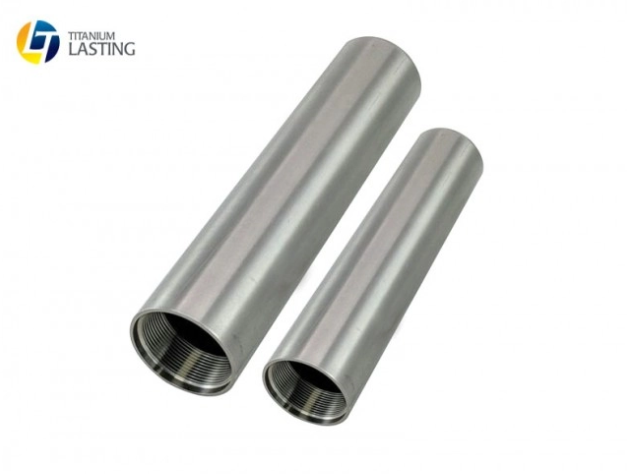
Extrusion is a common method for producing titanium tube material. In this process, a heated titanium billet is forced through a die to create the desired tube shape. This method is particularly useful for creating long, straight sections of titanium tubing with consistent cross-sections.
Pilgering is a cold-working process used to reduce the diameter and wall thickness of titanium tube material. This process allows for the production of tubes with precise dimensions and improved mechanical properties.
Welding plays a crucial role in the fabrication of titanium tube material. Techniques such as TIG (Tungsten Inert Gas) welding are commonly used to join titanium tubes or to create complex tubular structures. Special care must be taken during welding to prevent contamination and maintain the material's properties.
Cold drawing is another process used in the production of titanium tube material. This method involves pulling the tube through a series of dies to reduce its diameter and wall thickness. Cold drawing can improve the mechanical properties of the titanium tube and achieve tight dimensional tolerances.
The aerospace industry is one of the largest consumers of titanium tube material. Titanium tubes are used in aircraft hydraulic systems, engine components, and structural elements. The high strength-to-weight ratio of titanium tubes helps reduce the overall weight of aircraft, improving fuel efficiency and performance.
In chemical processing plants, titanium tube material is often used for heat exchangers, reactors, and piping systems. The excellent corrosion resistance of titanium tubes makes them ideal for handling aggressive chemicals and preventing contamination of processed materials.
Titanium tube material finds extensive use in marine environments due to its resistance to saltwater corrosion. Applications include desalination plants, offshore oil and gas platforms, and submarine components. Titanium tubes can withstand the harsh conditions of seawater without degradation, ensuring long-term reliability.
The biocompatibility of titanium tube material has led to its widespread use in the medical field. Titanium tubes are used in the manufacture of surgical instruments, dental implants, and prosthetic devices. The material's strength and lightweight nature make it particularly suitable for orthopedic implants.
High-performance sports equipment often incorporates titanium tube material. Bicycle frames, golf club shafts, and tennis rackets are just a few examples where the strength and lightweight properties of titanium tubes enhance athletic performance.
In the energy sector, titanium tube material is used in power generation facilities, particularly in steam turbines and heat exchangers. The material's resistance to high temperatures and corrosive environments makes it valuable in these applications.

One of the primary challenges associated with titanium tube material is its relatively high cost compared to other metals. The complex extraction and processing of titanium contribute to its higher price point. However, the long-term benefits often outweigh the initial investment, especially in applications where performance and longevity are critical.
Titanium tube material can be challenging to machine due to its high strength and low thermal conductivity. Special tools and techniques are often required to work with titanium tubes effectively. This can increase manufacturing time and costs.
Welding titanium tube material requires specialized equipment and expertise. The material is highly reactive at elevated temperatures and can easily become contaminated if proper precautions are not taken. This necessitates careful control of the welding environment to ensure the integrity of the welded joints.
The advent of 3D printing technologies is opening new possibilities for titanium tube material. Additive manufacturing allows for the creation of complex tubular structures with internal features that would be difficult or impossible to produce using traditional methods. This technology is particularly promising for aerospace and medical applications.
Research into nanostructured titanium alloys is ongoing, with the potential to create titanium tube material with even higher strength-to-weight ratios and improved properties. These advanced materials could further expand the applications of titanium tubes in various industries.
As sustainability becomes increasingly important, efforts are being made to improve the recycling of titanium tube material. Developing more efficient recycling processes could help reduce the cost of titanium and make it a more environmentally friendly option.
Titanium tube material stands as a testament to human ingenuity in materials science. Its unique combination of properties – lightweight, strong, corrosion-resistant, and biocompatible – has made it an indispensable material in numerous high-performance applications. From soaring through the skies in aircraft to saving lives in medical implants, titanium tubes continue to push the boundaries of what's possible in engineering and design.
As we look to the future, ongoing research and development in titanium alloys and manufacturing processes promise to unlock even more potential for this remarkable material. The challenges of cost and processing complexity are being addressed through innovative technologies and improved production methods. With its unparalleled performance in demanding environments, titanium tube material is set to play an increasingly important role in shaping the technologies of tomorrow.
Whether it's in the depths of the ocean, the vacuum of space, or inside the human body, titanium tube material continues to prove its worth as a versatile and reliable engineering material. As our understanding of this material grows and manufacturing techniques advance, we can expect to see even more innovative applications of titanium tubes across various industries.
The journey of titanium tube material from a laboratory curiosity to a critical component in advanced technologies is a testament to the power of materials science. As we continue to push the boundaries of what's possible in engineering and design, titanium tubes will undoubtedly remain at the forefront of innovation, enabling new achievements in aerospace, medicine, energy, and beyond.


