

Views: 389 Author: Lasting titanium Publish Time: 2025-07-13 Origin: Site


Content Menu
● Understanding Titanium Wire Forms
>> What is Straight Titanium Wire?
>> What is Coil Titanium Wire?
● Mechanical Properties and Performance
>> Elastic Modulus and Load Bearing
● Electrical Properties and Applications
>> Conductivity and Resistance
>> Thermal Behavior and Ramp-Up Time
● Practical Advantages of Straight Titanium Wire
>> Ease of Handling and Installation
● Practical Advantages of Coil Titanium Wire
>> Flexibility and Shock Absorption
>> Enhanced Mechanical Performance in Cyclic Loading
● Limitations and Disadvantages
● Industry-Specific Applications
>> Aerospace and Medical Devices
>> Electronics and Heating Elements
● Manufacturing Considerations
● Summary Table: Straight vs. Coil Titanium Wire
>> 1. When should I choose straight titanium wire over coil wire?
>> 2. What are the benefits of coil titanium wire in heating applications?
>> 3. Is coil titanium wire more expensive than straight wire?
>> 4. How does the shape of titanium wire affect its fatigue resistance?
>> 5. Can titanium wire be used in both electrical and mechanical applications?
Titanium wire has earned a prominent place in modern industry due to its exceptional properties such as high strength, corrosion resistance, and low density. These characteristics make it an indispensable material in sectors ranging from aerospace and medical devices to green energy and electronics. However, when selecting titanium wire for specific applications, one crucial decision is the wire's form: straight or coil. Each form offers unique mechanical and functional advantages that can significantly affect performance, cost, and suitability for different uses.
This article provides a comprehensive analysis of the pros and cons of straight versus coil titanium wire, expanding on their mechanical, electrical, and practical characteristics. By understanding these differences in detail, engineers, manufacturers, and end-users can optimize their material choices to enhance product reliability, efficiency, and longevity.
Straight titanium wire is a linear, unbent wire typically supplied in spools or cut lengths. It is prized for its uniformity, dimensional stability, and ease of integration into systems requiring rigidity. Straight wire is widely used in applications where the wire must maintain its shape under load, such as in structural supports, welding rods, and electrical conductors.
The manufacturing of straight titanium wire involves drawing titanium rods through progressively smaller dies to achieve precise diameters. The wire's surface can be finished to different specifications, such as polished bright or anodized, to suit aesthetic or corrosion resistance needs. This form is preferred in industries where precise mechanical properties and minimal deformation are essential, including aerospace and medical implant manufacturing.
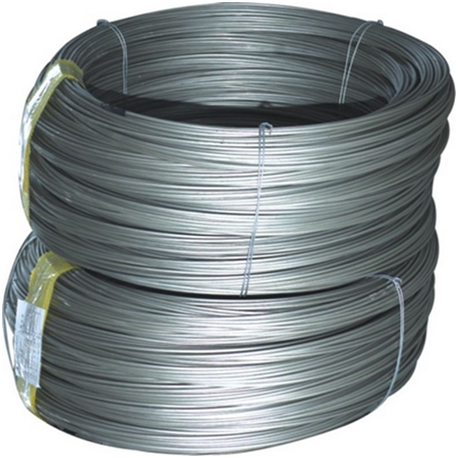
Coil titanium wire is wire that has been wound into helical or spiral shapes, resembling springs or loops. This coiled form introduces elasticity and flexibility, allowing the wire to stretch, compress, and absorb energy. Coiled titanium wire is often used in applications requiring dynamic mechanical responses, such as vibration dampers, flexible connectors, and heating elements.
The coiling process requires additional manufacturing steps, including winding the wire on mandrels and heat treatment to set the coil's shape and mechanical properties. Coiled wire can vary in coil diameter, pitch, and number of turns, each parameter tailored to specific mechanical or electrical requirements.
Straight titanium wire is inherently stiff and resists bending or deformation under load. This stiffness makes it ideal for applications where the wire must maintain a fixed shape and transmit forces directly, such as in aerospace fasteners or medical implants. The rigidity ensures dimensional accuracy and structural integrity over time.
In contrast, coil titanium wire is designed for flexibility. The helical shape allows the wire to elongate and compress, absorbing shocks, vibrations, and thermal expansion. This flexibility protects connected components from mechanical fatigue and damage in dynamic environments like automotive suspensions or flexible electrical circuits.
The choice between stiffness and flexibility depends on the application's mechanical demands. For static or load-bearing uses, straight wire is preferable; for dynamic or shock-absorbing roles, coil wire excels.
While the intrinsic elastic modulus of titanium material remains constant regardless of form, the effective stiffness of the wire varies with geometry. Straight wire exhibits high load-bearing capacity and minimal deformation under static loads. Coiled wire, due to its spring-like structure, has lower effective stiffness and can deform elastically under load, returning to its original shape when the load is removed.
This elastic behavior makes coil wire suitable for cyclic loading applications where repeated stretching and compression occur, such as in springs or flexible connectors. Straight wire, however, is better suited for applications requiring permanent shape retention and high static strength.
Titanium wire has moderate electrical conductivity, lower than copper or aluminum but sufficient for many specialized applications, especially where corrosion resistance is critical. Straight titanium wire provides a direct, low-resistance path for electrical current, making it suitable for wiring and conductive components that require stable, efficient conduction.
Coil titanium wire, by contrast, increases the effective length of the conductor within a compact volume. This longer path increases electrical resistance, which can reduce efficiency in high-current applications. However, this property can be advantageous in resistive heating elements where higher resistance generates heat.
In heating applications, coil titanium wire distributes heat more evenly across its surface due to the coil geometry, which exposes more wire surface area to the surrounding environment. This allows for quicker heating ramp-up times and more uniform temperature distribution, essential in industrial heaters or medical sterilization equipment.
Straight wire heats less uniformly and may take longer to reach operating temperatures, limiting its use in heating elements but making it suitable for applications where heat generation is undesirable.
Straight titanium wire is easier to handle, cut, and install, especially in applications requiring precise lengths and minimal bending. It is ideal for welding, structural supports, and electrical wiring where straight runs are necessary. Its linear form simplifies manufacturing processes and reduces the risk of kinks or unintended deformation during installation.
The dimensional stability of straight wire under load is a significant advantage in aerospace, medical, and precision engineering applications. It maintains its shape and mechanical properties over time, ensuring consistent performance in critical components such as fasteners, implants, and load-bearing structures.
Manufacturing straight wire is generally simpler and less expensive than producing coil wire. The absence of coiling steps reduces processing time and tooling costs. For applications where flexibility is not required, straight wire offers a cost-effective solution without compromising performance.

Coiled titanium wire's flexibility allows it to absorb mechanical shocks, vibrations, and thermal expansion. This makes it indispensable in dynamic mechanical systems such as springs, flexible electrical connectors, and vibration dampers. The coil form reduces stress concentrations and fatigue damage, extending component life.
Coiling enables long lengths of wire to be stored and deployed in compact spaces. This is particularly useful in applications with limited room or where adjustable wire length is needed, such as in medical devices like stents or in compact heating elements.
Coiled wire performs better under repeated loading and unloading cycles, resisting fatigue and failure better than straight wire. This property is critical in applications where components undergo frequent mechanical stress, such as automotive suspensions or aerospace vibration isolators.
- Lack of flexibility: Straight titanium wire cannot absorb mechanical shocks or vibrations, making it susceptible to fatigue failure in dynamic environments.
- Storage and transport: Long straight wires require more space and careful handling to prevent bending or damage, increasing logistical complexity.
- Higher electrical resistance: The increased length and contact points in coils raise resistance, which can reduce efficiency in electrical applications.
- Manufacturing complexity: Coiling adds processing steps, increasing production time and costs.
- Dimensional variability: Coiled wire may deform under load, which can be a disadvantage in applications requiring precise dimensional control.
In aerospace, straight titanium wire is used extensively for fasteners, structural components, and wiring where rigidity and reliability are paramount. Coil wire finds applications in vibration dampers, flexible connectors, and springs that absorb mechanical stresses.
In medical devices, straight wire is used for implants, surgical tools, and orthopedic fixation devices where precise dimensional stability and biocompatibility are critical. Coil wire is employed in orthopedic springs, stents, and flexible connectors where elasticity and shock absorption improve patient outcomes.
In solar and wind energy systems, straight titanium wire is favored for structural supports and stable electrical connections, while coil wire is used in flexible connectors and vibration-absorbing components to enhance system durability.
Coil titanium wire is preferred in resistive heating elements due to its ability to heat evenly and withstand thermal cycling. Straight wire is used in electrical pathways where minimal resistance and stable conduction are required.
Straight titanium wire production involves drawing titanium rods through dies to achieve precise diameters, followed by surface finishing processes such as polishing or anodizing. The wire is then spooled or cut to length for shipment.
Coiling requires additional steps where the wire is wound around mandrels or shaped into springs. Heat treatment is often applied to set the coil shape and optimize mechanical properties. These additional processes increase production complexity and cost.
Both wire forms require rigorous quality control to ensure dimensional accuracy, mechanical properties, and surface finish. Coiled wires undergo additional inspections to verify coil geometry, spring constants, and fatigue resistance, ensuring performance under cyclic loads.
While straight wire production is generally less expensive, the total cost of ownership must consider application-specific factors. Coil wire's durability in dynamic environments and resistance to fatigue can reduce replacement frequency and maintenance costs, offsetting higher initial expenses. Selecting the appropriate wire form based on application needs can lead to significant long-term savings.
| Feature | Straight Titanium Wire | Coil Titanium Wire |
|---|---|---|
| Flexibility | Low | High |
| Mechanical Strength | High stiffness and load bearing | Elastic, absorbs shocks |
| Electrical Resistance | Lower (shorter length) | Higher (longer wire length) |
| Heat Distribution | Less uniform | More uniform, faster ramp-up |
| Handling & Installation | Easier to handle and install | More complex due to coil shape |
| Space Efficiency | Requires more storage space | Compact storage and deployment |
| Cost | Lower manufacturing cost | Higher due to additional processing |
| Fatigue Resistance | Lower in dynamic applications | Higher due to elasticity |
Straight titanium wire is ideal when rigidity, dimensional stability, and low electrical resistance are essential, such as in structural supports, fasteners, or direct electrical connections.
Coil titanium wire heats evenly and rapidly due to its geometry, making it suitable for resistive heating elements and applications requiring thermal cycling.
Yes, coil wire generally costs more because of additional manufacturing steps, but its enhanced durability and performance in dynamic environments often justify the investment.
Coiled wire has higher fatigue resistance as its helical shape absorbs mechanical stresses better than straight wire, which is more prone to cracking under cyclic loads.
Absolutely. Titanium wire's unique combination of mechanical strength, corrosion resistance, and electrical conductivity makes it suitable for a wide range of applications, with the choice of straight or coil form depending on specific needs.


