

Views: 358 Author: Lasting titanium Publish Time: 2025-10-03 Origin: Site


Content Menu
● Aerospace Industry: Advanced Structural and Mechanical Components
>> Aircraft Structural Frames and Landing Gear
>> Engine Shafts and Turbine Components
● Medical Sector: Biocompatible Implants and Surgical Instruments
>> Bone Replacement and Orthopedic Devices
>> Surgical Tools and Medical Equipment
● Marine Engineering: Corrosion-Resistant Structural Applications
>> Shipbuilding and Offshore Components
>> Saltwater Desalination and Water Processing Equipment
● Automotive and Motorsport Applications: Lightweight Strength and Durability
>> High-Performance Suspension and Engine Systems
>> Emerging Uses in Consumer Vehicles
● Chemical and Industrial Processing: Durable and Corrosion-Resistant Equipment
>> Chemical Reactor Components and Heat Exchangers
>> Precision Industrial Machinery Parts
Titanium round bars have revolutionized modern engineering due to their remarkable combination of properties including lightweight, high strength, excellent corrosion resistance, and biocompatibility. This unique set of attributes has opened avenues for their use in many critical fields where performance and reliability cannot be compromised. Expanding on previous discussions, this article provides an in-depth exploration of the top five applications of titanium round bars, backed by detailed technical insights and practical examples from cutting-edge industries.
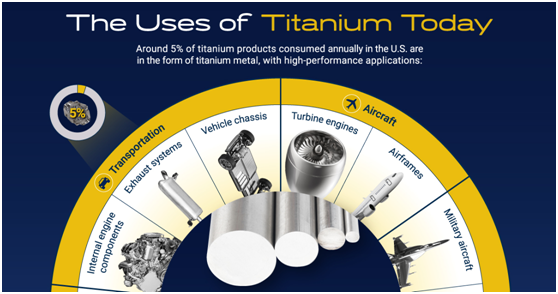
In the aerospace sector, titanium round bars are fundamental for building lightweight yet extremely strong aircraft frames and landing gear. Their high strength-to-weight ratio significantly improves fuel efficiency by reducing overall aircraft mass without sacrificing safety or structural integrity. In addition, titanium's resistance to corrosion—especially in humid or marine environments—prevents premature degradation of vital components exposed to varying weather conditions. The fatigue resistance of titanium alloys further guarantees prolonged service life for these parts subjected to repeated mechanical stress cycles during takeoff, flight, and landing.
Manufacturers use specfic grades, such as Grade 5 titanium, which is prized for its tensile strength and capability to maintain mechanical properties at elevated temperatures experienced during aerospace operations. Sophisticated machining processes tailor titanium round bars into complex forms including wing spars, bulkheads, and landing gear rods. Its thermal stability also permits proximity to engines and exhaust systems where other metals might fail.
Titanium round bars are essential in producing engine shafts and turbine parts due to their ability to resist wear, fatigue, and extreme thermal cycles. Their use reduces engine weight, contributing to overall aircraft performance enhancements, fuel economy, and emissions reduction. The parts' corrosion resistance against combustion gases and environmental contaminants prolongs operational reliability between maintenance cycles, which is critical for airline operational costs and safety.
Titanium's biocompatibility and mechanical compatibility with the human skeletal system make titanium round bars ideal for orthopedic implants such as bone plates, screws, joint replacements, and spinal fixation devices. Its low modulus of elasticity closely mimics that of bone, reducing stress shielding and promoting better integration, which facilitates healing and reduces complications.
Custom titanium implants machined from round bars offer precisely engineered fit and strength, enabling personalized solutions in trauma care, reconstructive surgery, and prosthetics. Additionally, titanium's inertness prevents adverse biological reactions, making it the preferred material for long-term implantation.
Titanium round bars also serve as raw material for high-quality, lightweight surgical instruments. Their resistance to corrosion from sterilization chemicals, combined with superior strength, ensures longevity and dependability in demanding surgical environments. The non-magnetic nature of titanium is advantageous in procedures involving MRI scanning, avoiding interference and ensuring patient safety. Titanium tools are particularly valued for reducing surgeon fatigue during prolonged operations through their reduced weight without loss of robustness.
Titanium's exceptional resistance to seawater corrosion makes titanium round bars invaluable in manufacturing ship parts, offshore drilling equipment, and subsea pipelines. The marine environment is highly corrosive and typical steel components are prone to rust and structural failure without costly maintenance.
Titanium components crafted from round bars provide durable, lightweight, and maintenance-free solutions for hull reinforcements, propeller shafts, and fasteners. This reduces downtime and improves operational safety in critical maritime infrastructure. Long-term exposure to saltwater and marine organisms has proven titanium's superiority in sustaining structural integrity and minimizing replacement frequency.
In desalination plants and marine chemical processing, titanium bars are used to produce heat exchangers, valves, and pumps due to their resistance to chloride ion attack and biofouling. These titanium-based components maintain operational efficiency and safety while reducing the environmental impact and energy consumption typical of water treatment facilities. With increasing global demand for fresh water, titanium's role in advancing seawater desalination technology is becoming even more important.
Titanium round bars are extensively used in automotive engineering to fabricate lightweight yet durable suspension components, engine valves, exhaust systems, and connecting rods. By reducing component mass without sacrificing mechanical strength, titanium enhances overall vehicle performance, handling, acceleration, and fuel efficiency.
In motorsports, where every fraction of a second counts, titanium components—engineered from round bars—deliver superior fatigue resistance and heat tolerance enabling higher engine speeds and longer component lifespans. These attributes help racing vehicles achieve faster lap times and greater reliability on demanding tracks.
The adoption of titanium in premium consumer vehicles is rising, with manufacturers incorporating titanium parts for weight reduction and enhanced durability. Efforts focus on striking a balance between cost and performance to bring titanium benefits to wider markets, promoting energy efficiency and reduced emissions in line with global environmental goals.
Titanium round bars are a backbone material in chemical plants for making reactor shafts, heat exchanger tubes, and valves. Their resistance to aggressive chemicals including acids and alkalis prevents corrosion failures that would otherwise jeopardize plant safety and productivity.
In heat exchangers, titanium's thermal conductivity coupled with corrosion resistance improves heat transfer efficiency and extends equipment lifespan, reducing maintenance costs and operational downtime. The reliability of titanium components plays a critical role in ensuring continuous operation of chemical processes.
Beyond chemical plants, titanium round bars produce shafts, fasteners, and precision parts for machinery working in harsh environments involving high temperatures, pressures, or corrosive media. The material's low thermal expansion coefficient ensures dimensional stability, critical for high-precision manufacturing and power generation equipment.
1. Why are titanium round bars favored in aerospace over other metals?
Their outstanding strength-to-weight ratio combined with corrosion and fatigue resistance optimize aircraft performance and durability.
2. What makes titanium especially suitable for medical implants?
Titanium's biocompatibility, corrosion resistance, and elastic modulus similar to bone minimize rejection and stress shielding.
3. How do titanium bars improve maritime equipment longevity?
Excellent corrosion resistance to saltwater environments significantly reduces maintenance and replacement frequency.
4. What benefits do titanium components bring in automotive and motorsport applications?
Lightweight, high strength, and heat resistance enhance vehicle performance, fuel efficiency, and component lifespan.
5. How does titanium contribute to chemical processing safety?
Its resistance to chemical attack and thermal efficiency ensures reliable, long-lasting industrial equipment.


